Festival Gastro Caribe Showcases the Caribbean’s Unique Cultures and Food

Promotional poster of the Festival Gastro Caribe. Submitted by Keywanda Battle.

Promotional poster of the Festival Gastro Caribe. Submitted by Keywanda Battle.

Kahila Miller, originally from the Carribean islands of Antigua and Barbuda, has lived in Pittsburgh for 29 years and has always tried to introduce people to Caribbean culture during her time in the city.

From her first venture, “African-American Caribbean Village,” a memorabilia store of various the Caribbean and African Nations “Tek-kit-Eeze with Love,” a restaurant. Her current business is “Caribbean Village,” located in Monroeville Mall, a memorabilia store just like the first business. “If you ever took a vacation and forgot to pick up a souvenir for a friend or family member, we’re your backup,” said Miller, while setting up a mannequin.

On July 13th, she is holding her 2nd Annual Festival Gastro Caribe from 3 pm to 11 pm at Mellon Park in East Liberty. The festival’s goal is to introduce the food, culture, and pastimes of the Carribean.

The first festival was recognized by the Commonwealth of Pennsylvania State Representative Edward C. Gainey, for their efforts in connecting the Carribean culture to Pittsburgh.

“We were very pleased with that,” said Keywanda Battle, Administrative Partner for the Festival Gastro Caribe. “It gives us the impetus, and it encourages our future vision for inclusion and success for Caribbean people and their place in Pittsburgh.”

The idea for the festival came from the other heritage festivals that happen annually in Pittsburgh, her time living in Brooklyn, New York, a hub for people who share her heritage and other Carribean festivals like the Caribana in Toronto.

Promotional poster of some of the food from various Caribbean countries. From Keywanda Battle.

Promotional poster of some of the food from various Caribbean countries. From Keywanda Battle.

“My dream is to have the same thing happen in Pittsburgh,” explained Miller. “We have a lot of West Indies people, [another name for the Caribbean], in the surrounding states that will attend our activities.”

Carribean traditions like games of Netball, a basketball-style sport that women from the islands play will be a part of the festivities and entertainment like dance groups and drummers are an attraction as well.

There are plans for a museum at the festival of all the Caribbean nations so people can learn more about other countries.

“We plan to have a roundtable and have people introduce themselves [and where they are from],” said Miller. “We can show that we have quite a few different islanders live here.”

Nations like Antigua, Trinidad, Jamaica, the Virgin Islands, Haiti, Puerto Rico, and the Bahamas will have vendors showcasing their nation’s food.

“I can’t bring you the sunshine, I can’t bring you the beaches, but I can bring you the foods & cultural feel,” said Miller.

Miller and Battle are excited about this year’s turnout vendor wise. Many of their vendors from the first event, their “anchor vendors” are returning and new vendors are hoping to become regulars.

New vendor, Kendrick Brown was born in Cat Island, Bahamas but was raised in Coconut Grove, a Bahamian neighborhood of  Miami, Florida. He grew up around learning the traditions of the Bahamas.

“I started cooking with my grandmother she started me off with Bahamian cuisine,” said Brown. “I went to culinary school, and I went back to my roots.”

Since moving to Pittsburgh in January 2015, he had been looking for ways to bring Bahamian food to Pittsburgh. He met Miller at her store, and she told him about the festival, and he was interested in signing up for it. He lost her contact info but thanks to a co-worker’s internet search, he feels he’s on the right path.

“I want to bring a little Bahamian culture as far as I can go with it,” said Brown. “At some point, you’re probably thinking about going to the Bahamas, so I want to be able to bring a little bit of agriculture to you.”

Brown says he’s cooking conch, a type of meat that comes from a conch shell. Not many people know that the shell, usually a souvenir has edible meat. When cracked out of the shell, it can be served raw or cooked in a variety of ways. He plans to fry the meat, put it in salads and many more.

“It’s well worth the try,” said Brown. “I’m hoping people come out and try the taste of sunshine!”

Ukrainian Professional Boxers Fighting For Their Dreams in Pittsburgh

Oleg Dovhun (Left) and Lyubomyr Pinchuk (Right). Posing in the ring at the Conn-Greb Boxing Gym in North Oakland. Photos by Brett Rothmeyer.

Oleg Dovhun (Left) and Lyubomyr Pinchuk (Right). Posing in the ring at the Conn-Greb Boxing Gym in North Oakland. Photos by Brett Rothmeyer.

When Lyubomyr “The Demolition Man” Pinchuk, 22, turned 18, he sent messages to boxing trainers all over America asking if they wanted to train him for his professional career. Through a translator, he sent 500 messages in broken English via Facebook and email, receiving only 10 or 20 responses.

Lyubomyr Pinchuk training in the ring at the Conn-Greb Boxing Gym in North Oakland. Photo by Brett Rothmeyer.

Lyubomyr Pinchuk training in the ring at the Conn-Greb Boxing Gym in North Oakland. Photo by Brett Rothmeyer.

“He emailed that he wanted to come to America ‘to become champion on them world,'” said Michael McSorley, his trainer and cornerman while watching Pinchuk’s longtime boxing partner Oleg “The Ukraine Pittbull” Dovhun, 25, work the heavy bag.

Pinchuk and Dovhun trained together while with the amateur Ukrainian National Boxing Team. “We’ve known each other for seven years. We even went to the same university,” said Pinchuk before his training session at Conn-Greb Boxing Gym in North Oakland.

Oleg Dovhun (Left) punching white tubes held by Michael McSorley (Right) at the Conn-Greb Boxing Gym. Photo by Brett Rothmeyer.

Oleg Dovhun (Left) punching white tubes held by Michael McSorley (Right) at the Conn-Greb Boxing Gym. Photo by Brett Rothmeyer.

Since moving to Pittsburgh in February 2017, the Ukrainian duo have gained regional acclaim with their professional boxing careers in America. Ukrainian fighters usually go to bigger cities outside of Ukraine than Pittsburgh for professional training.

Their journeys through boxing began at young ages. Pinchuk started boxing at age 7 and Dovhun began training at age 10. They amassed prolific amateur careers.

Pinchuk fought as an amateur 250 times and captured two Ukrainian National Championships. Dovhun fought 325 times and captured four championships.

Michael McSorley at the end of Spring Slugfest at the Priory Grand Hall in Pittsburgh on March 2nd, 2019. Photo by Brett Rothmeyer.

Michael McSorley at the end of Spring Slugfest at the Priory Grand Hall in Pittsburgh on March 2nd, 2019. Photo by Brett Rothmeyer.

McSorley and Pinchuk emailed and talked over a two-year period. Those interviews were translated by Anna Dasta, wife of Tom Dasta, a fellow cornerman. He introduced Dovhun to McSorley as well. Unlike Pinchuk, Dovhun didn’t go searching around the country for boxing coaches.

Michael McSorley (Left) training with Lyubomyr Pinchuk at the Conn Greb Boxing Gym in North Oakland. Photo by Brett Rothmeyer.

Michael McSorley (Left) training with Lyubomyr Pinchuk at the Conn Greb Boxing Gym in North Oakland. Photo by Brett Rothmeyer.

When Lyubomyr introduced him to McSorley, he knew he wanted to work with him. “I like working with him,” said Dovhun, after his training session. “He’s a very good coach.”

Pinchuk’s persistence impressed him, making him rethink his plans of not importing the two standouts. “I was impressed with them,” McSorley said. “I knew we were in store for something great.”

Michael McSorley (Left) working with Lyubomyr Pinchuk (Right) at the Conn-Greb Boxing Gym in North Oakland. Photo by Brett Rothmeyer.

Michael McSorley (Left) working with Lyubomyr Pinchuk (Right) at the Conn-Greb Boxing Gym in North Oakland. Photo by Brett Rothmeyer.

McSorley, a Southside resident and boxing lifer, began boxing in his freshman year of college. After graduating, he found work as a cut-man, someone who fixes facial damage during bouts for fighters like Sammy Vasquez, a professional boxer and Iraq veteran with a 21-2 record.

“I spent a lot of time in gyms,” said McSorley. “One thing led to another and fighters started asking me to train them.” In addition to training, he manages and promotes matches of all his fighters through Integrity Fighter Management, a fight team ran by himself and his business partner J.J. Richardson.

Lyubomyr Pinchuk, training at the Conn-Greb Boxing Gym. Photo by Brett Rothmeyer.

Lyubomyr Pinchuk, training at the Conn-Greb Boxing Gym. Photo by Brett Rothmeyer.

He trains the Ukrainians out of the Conn-Greb Boxing Gym, on the property of an apartment complex and parking garage he owns in North Oakland. The gym is named after Billy Conn and Harry Greb, two legends of boxing, born and raised in Pittsburgh.

Entering the gym, it looks like an underground fight club. The boxing ring is in the middle of the gym, with heavy bags on one side and weightlifting equipment on the other “We had a nice gym in Ukraine, but I’m okay with this gym,” said Dovhun. “It’s not where I train, it’s how I train and the coaching I get.”

Michael McSorley working with Lyubomyr Pinchuk at the Conn-Greb Boxing Gym in North Oakland. Photo by Brett Rothmeyer.

Michael McSorley working with Lyubomyr Pinchuk at the Conn-Greb Boxing Gym in North Oakland. Photo by Brett Rothmeyer.

Before coming to Pittsburgh, McSorley, Dovhun and Pinchuk talked about the fight scene, gyms and neighborhoods around the city. “I felt like they knew the characters here and some of the gyms before they came to town,” said McSorley.

“I learned more [about the Ukrainian community in Pittsburgh] once they got here.” Their first experience of Ukrainian life in America was at St. Mary’s Ukrainian Orthodox Church in McKee’s Rocks.

Oleg Dovhun after the end of his sparring session at Conn-Greb Boxing Gym in North Oakland. Photo by Brett Rothmeyer.

Oleg Dovhun after the end of his sparring session at Conn-Greb Boxing Gym in North Oakland. Photo by Brett Rothmeyer.

“It’s pretty cool that two Ukrainian kids are making waves for boxing in Pittsburgh,” said Father Tim Thomson, a pastor for seventeen years at the church. “Pittsburgh hasn’t been a boxing hub in a long time.”

Lyubomyr Pinchuk, training at the Conn-Greb Boxing Gym. Photo by Brett Rothmeyer.

Lyubomyr Pinchuk, training at the Conn-Greb Boxing Gym. Photo by Brett Rothmeyer.

Thomson grew up a boxing fan watching Ali and Foreman and he has seen Paul Spadafora fight people at the A.J. Palumbo Center. He goes to their fights when possible and is excited about boxing’s future in Pittsburgh.

Outside of the ring, Pinchuk and Dovhun live normal lives. They do contracting work in construction and plumbing. Dovhun stays in contact with his girlfriend and parents. Pinchuk keeps up with friends,family and his old boxing coach.

Lyubomyr Pinchuk’s hand raised in victory after defeating Thad Berkhousen via second-round TKO by Referee Tim Shipley (left). This was his third title defense. Photo by Tyler Polk.

Lyubomyr Pinchuk’s hand raised in victory after defeating Thad Berkhousen via second-round TKO by Referee Tim Shipley (left). This was his third title defense. Photo by Tyler Polk.

Initially, they went to the church every Sunday, meeting people who immigrated to America or have a family history in Ukraine. Pinchuk doesn’t go to church anymore, but Dovhun still takes the hour and a half trip from their apartment in Bloomfield to McKee’s Rocks every Sunday, despite being raised Catholic.

“There are very nice people at church,” said Dovhun. “I like going there. They all support my fights.”

In addition to his role as a pastor, he is also the Vice President of the Ukrainian Community of Western Pennsylvania.

Lyubomyr Pinchuk (Left) throwing a shot at Thad Berkhousen (Right) at the Spring Slugfest in the Priory Grand Hall in Pittsburgh. Photo by Brett Rothmeyer.

Lyubomyr Pinchuk (Left) throwing a shot at Thad Berkhousen (Right) at the Spring Slugfest in the Priory Grand Hall in Pittsburgh. Photo by Brett Rothmeyer.

“Our goal is to promote the culture of Ukrainians and create a fellowship with others,” said Thomson. “Our Members range from 1st to 3rd generation Ukrainian”.

According to Popular Pittsburgh, a website informing people of Pittsburgh’s cultural history, the city is home to the fourth largest Ukrainian Population in the United States.

Ukrainian people have immigrated to Pittsburgh in waves. The first wave was at the beginning of the 20th century. Ukrainian immigrants would work primarily in the mills and mines.

Clare Burke, President of the American Boxing Federation, takes a video on her phone of Pinchuk’s fight at Spring Slugfest at the Priory Grand Hall in Pittsburgh on March, 2nd 2019. Photo by Brett Rothmeyer.

Clare Burke, President of the American Boxing Federation, takes a video on her phone of Pinchuk’s fight at Spring Slugfest at the Priory Grand Hall in Pittsburgh on March, 2nd 2019. Photo by Brett Rothmeyer.

Thomson says Immigration was steady from the early ’80s to the ’90s. They came to America because of economic and political reasons. The third wave is currently underway. Ukrainian immigrants are coming for economic reasons as well and because of the Ukrainian Crisis of 2014.

“It’s a shame because it’s a beautiful country with many resources,” says Thomson. “People are leaving for a better life, just like Oleg and Lyubomyr with boxing.”

Douglas Cavanaugh, a friend of McSorley, was one of the first people McSorley told about the possibility of bringing in the Ukrainian fighters.

Daron “Sweet Tay” Williams (Left) and Oleg Dovhun (Right) battle for the vacant ABF USA Super Bantamweight Championship. Photo by Brett Rothmeyer.

Daron “Sweet Tay” Williams (Left) and Oleg Dovhun (Right) battle for the vacant ABF USA Super Bantamweight Championship. Photo by Brett Rothmeyer.

“He contacted me when they were still in Ukraine,” said Cavanaugh, who has written about boxing for 25 years. “It was the middle of the night when he told me they were coming here. He was very excited.”

It’s rare for international fighters to go outside the big fight towns. Pinchuk and Dovhun stepping into the city in 2017 may have made history by stepping into Pittsburgh. “They usually go to bigger fight towns like New York, Philadelphia, and Boston,” said Cavanaugh. “As far as I know from my research, they are the first Ukrainian fighters to train in Pittsburgh.”

Cavanaugh lives in Burbank, Calif., but he documents the hidden history of Pittsburgh boxing on his Facebook page, “Pittsburgh Boxing: A Pictorial History.” He talks about the many fighters that are from, trained, or fought in Pittsburgh.

PA Announcer Matt Antonucci (Left) and Oleg Dovhun (Right) after his victory for the ABF USA Super Bantamweight Championship. Photo by Tyler Polk

PA Announcer Matt Antonucci (Left) and Oleg Dovhun (Right) after his victory for the ABF USA Super Bantamweight Championship. Photo by Tyler Polk

One fighter from Ukraine was a fan favorite during boxing’s boom in Pittsburgh.

Benny “Little Fish” Bass, born in Kiev, Ukraine, immigrated with his family to Philadelphia, Pennsylvania when he was three. Bass fought out of Philadelphia in the featherweight and lightweight divisions. He was the first ever Ukrainian champion in boxing history winning titles in both divisions.

Daron “Sweet Tay” Williams (Left) sent off balance by Oleg Dovhun (Right) during their bout for the vacant ABF USA Super Bantamweight Championship. Photo by Brett Rothmeyer.

Daron “Sweet Tay” Williams (Left) sent off balance by Oleg Dovhun (Right) during their bout for the vacant ABF USA Super Bantamweight Championship. Photo by Brett Rothmeyer.

Jack Dempsey, a boxing legend in his own right, called him the greatest boxer he had ever seen. “He fought a couple of times in Pittsburgh,” said Cavanaugh. “He was popular in the Lower Hill District and the rest of the Pittsburgh Ukrainian community during Boxing’s heyday in town.”

Pittsburgh fighters tended to be second generation fighters in the 1920s, 30s and 40s in Pittsburgh. Cavanaugh lists second-generation fighters like George Chip, who had Lithuanian roots, Teddy Yarosz with Polish roots, Fritzie Zivic had Croatian roots, and Billy Soose was Hungarian.

“These fighters looked at how their parents worked in the mills and said ‘I’m not going to kill myself on the assembly line. I’ll become a prizefighter and make a month’s worth of pay in a day,'” said Cavanaugh.

Cavanaugh believes Pinchuk and Dovhun, first-generation immigrants, carry similar traits to those fighters. “They represent everything Pittsburgh boxing was,” said Cavanaugh. “Immigrants that came over from foreign countries to make a better life for themselves.”

Lyubomyr Pinchuk (Left) throwing a shot at Thad Berkhousen (Right) at the Spring Slugfest in the Priory Grand Hall in Pittsburgh. Photo by Brett Rothmeyer.

Lyubomyr Pinchuk (Left) throwing a shot at Thad Berkhousen (Right) at the Spring Slugfest in the Priory Grand Hall in Pittsburgh. Photo by Brett Rothmeyer.

Watching these two train makes it clear when tell that when these guys throw a punch, they mean business. Seeing McSorley and Pinchuk train with the fight mitts. The loud thud of the pad and the loud effort from Pinchuk. Every strike is precise. Right on the pad with little effort.

Same with Dovhun on the heavy bag, his combinations are no longer than three strikes akin to what happens in a real fight. Their training is always heavy on conditioning. Technique becomes another point of emphasis closer to fight night.

“Our training is rare on flash, it’s more grounded in reality,” said McSorley. “It’s rare do you see more than three punches in a combination.”

They fight in two different weight classes. Pinchuk is a lanky cruiserweight, a weight class of 200 pounds in between the smaller light heavyweight division and the bigger heavyweight division. Dovhun is a quick southpaw in the super bantamweight division, where fighters weigh 122 lbs.

Both have winning records in their young professional careers since debuting in March 2017. Pinchuk has a 10-1 record, seven wins by knockout. Dovhun is 8-0 in his career, with two wins by knockout.

McSorley believes that their willingness to fight anyone he can put in front of them will help them and endear them to the community. “I think in the long run they will progress faster and in the short term, people enjoy the challenges they are willing to take,” said McSorley.

Every event that Integrity Fighter Management holds, no matter the location; The Carnegie Library, Monroeville Convention Center or The Priory Grand Hall, the crowd gets bigger, drawing up to 700 people for their fights.

The demand to see these two in person has gotten higher every show. “It’s starting to come together, there was a lot of Ukrainian supporters at the last show,” said McSorley. “Word getting out has helped, people had a good time, and they bring more back each time.”

Rosalindo Morales (Left) and Oleg Dovhun (Right) sparring at the Conn-Greb Boxing Gym. Photo by Brett Rothmeyer.

Rosalindo Morales (Left) and Oleg Dovhun (Right) sparring at the Conn-Greb Boxing Gym. Photo by Brett Rothmeyer.

Ron Witkosky, a friend of McSorley for five years has been to every one of the shows sponsored by Integrity Fighter Management. He said he is in awe of seeing these fights in person and enjoys the atmosphere of the intimate venues.

“A lot of people in the audience are directly invested in the fighters like me,” said Witkosky. “When they are invested it’s much more exciting. Mike and J.J. really do a great job with these shows.”

Dovhun and Pinchuk have captivated boxing fans outside of town too. Phil Chalmers has been to all their fights as professionals along with his brother Paul. He cites the times they fought in West Virginia at the Moundsville Penitentiary as an example of how entertaining they are.

“They love them down there, even in [Philadelphia],” said Chalmers, who lives in the Southside. “They can see greatness; they know they are going to be great.

They have received attention from regional sanctioning organizations, including the American Boxing Federation (ABF), which gave them their first professional title shots.

The ABF was founded in February 2018 and is one of the busiest regional and national sanctioning body in the western hemisphere since its inception. Their goal is to be a starting point for a future world champion for one of the Big Four organizations of boxing.

“Oleg is exceptional, and Lyubomyr is very good as well,” said Clare Burke, the vice president of the ABF. “I’m around the country almost every weekend and what I’ve seen from them is exceptional.”

McSorley sent her some tape of Pinchuk last summer. She was impressed and offered him a chance at the vacant ABF USA cruiserweight championship. He defeated Lamont Capers by unanimous decision for his first pro championship in August 2018.

Since capturing the title, he’s made two defenses. Burke believes his reign has been great so far. “It’s been great for the ABF as well, we’ve even got some exposure from Ukraine,” said Burke. “He’s a role model for future fighters. You can’t ask for anything better.”

When Burke went to the Priory Grand Hall to Pinchuk’s first title fight is when she saw Dovhun fight for the first time. She liked a lot of his performance that night and wanted to give him a future chance at gold. “I called [ABF President] Jeremy Lantz to tell him how good he was and sent him a video of the fight.”

Dovhun’s chance came this past March for the ABF USA Super Bantamweight Championship. He battled fellow undefeated fighter, Daron “Sweet Tay” Williams. Dovhun won the championship by unanimous decision.

Burke believes that Williams is good and still developing as a fighter, but Oleg was the better fighter that night. “Oleg made him work [in the fight],” said Burke. “He’s awkward for fighters because of the Ukrainian style’s contrast to American boxing techniques.”

The duo are champions of the ABF’s USA division. Which recognizes them as champions of the United States. “It feels good to be a champion,” said Dovhun. “It was a big fight, and I want the next fight to be bigger.”

The crowds cheer loudly at their fights. But, the loudest people in the room are in their corner. McSorley and Dasta are usually yelling instructions primarily in English, but they used to yell the word “attack” in Ukrainian.

“When it came towards communicating boxing terms, they’ve understood from day one,” said McSorley. “I said that word in their early fights, but not much anymore.”

McSorley’s training has created an interesting blend of their natural European style, with techniques studied by professional boxers in America.

“Most guys I rain tend to be high-pressure counter punchers,” said McSorley. “I hear from people who’ll say Oleg is a high tempo, aggressive fighter, and Lyubomyr is an excellent counter puncher.”

He said getting them the feel for the professional style after so many fights as amateurs was the biggest challenge when he started training them.

“Amateur boxing is getting more shots off for points,” said McSorley. “When you get off a high number of shots, you’re not throwing power shots.” He said the two are now fighting on their back knee a little more, giving their punches a meaner intent.

Travis “The Terror” Clark, a 13-2 Heavyweight, is a fellow member of Integrity Fighter Management. He has sparred with both men and speaks highly of both. “They are the real deal,” said Clark. “They are amazing, great people and great athletes.”

He first met them when he was getting ready for a title fight and was asked to spar Lyubomyr. He thought it was going to be an easy session, but it resembled a true contest.

“He was fast and was hitting me hard,” said Clark. “I was ready to get him, but I settled down and got used to his speed and his power. Not many people are going to mess with that kid.”

Clark also sparred with Dovhun, who at super bantamweight to his heavyweight is a large size disadvantage for the super bantamweight. “It’s like getting stung by a bunch of bees,” Clark joked.

In preparation for his fight against Williams, Oleg sparred with someone closer to his size in Rosalindo Morales, a 3-0 super lightweight. “It was a really good session, I was getting ready for a fight as well”, said Morales. “I thank Mike and Oleg for the opportunity.”

Lyubomyr Pinchuk (Right) sparring with two-time IBF Cruiserweight Champion Steve “USS” Cunningham (Left). Photo by Michael McSorley.

Lyubomyr Pinchuk (Right) sparring with two-time IBF Cruiserweight Champion Steve “USS” Cunningham (Left). Photo by Michael McSorley.

Pinchuk has a unique opportunity to spar with former two-time IBF Cruiserweight Champion Steve “USS” Cunningham. “We’ve been very lucky to have him as a sparring partner and a friend”, said McSorley. “They spar well against each other, but they don’t take it easy on each other.”

Cunningham met McSorley through Facebook. He was here with his family in Pittsburgh because his daughter needed a heart transplant. He asked if anyone had a gym for him and his kids to train in and McSorley obliged inviting him out to Conn-Greb Boxing Club.

“We went to his gym, me and my boys got a nice workout in, we’ve become good friends,” said Cunningham.

When he asked Cunningham if he wanted to work with Pinchuk, he saw it as a chance to be a mentor to a younger fighter, like three-time heavyweight champion Chris Byrd mentored him. 

“I learned so much from a more skilled veteran, just from sparring with him”, said Cunningham. “It feels like this is what I’m supposed to be doing, helping this young man reach his goals”.

Pinchuk said he’s thankful to spar with an experienced fighter. “Every time we ask him to spar, he never says no,” said Pinchuk. “He’s a two-time champion, a great fighter and he teaches me a lot.

The motto for McSorley’s duo is “Onward and Upward!” What keeps them focused is always having a goal; it’s what they talk about on long drives to out of town fights or sparring sessions about their intentions. “I feel without any goals you’re like a boat at sea without a rudder,” said McSorley.
Their goals are to continue upping the competition and get into the top-10 world rankings in their divisions. On Boxrec, an online boxing directory, Dovhun is the number one Ukrainian super bantamweight.

On the road to becoming the number one boxer in the world, he’s thinking big. “I want more chances at titles,” said Dovhun. “I want to be a world champion in the next two years.”

Another goal the two share is stepping up the length of their bouts. On June 7, Pinchuk will be in his first 10-round fight against Taylor Duerr in Detroit. “I hope I can do more and get to a higher level,” said Pinchuk. “I want to follow this dream.”

Pinchuk and Dovhun are scheduled to defend their titles in Pittsburgh at the Carnegie Library of Homestead on July 13th.

Blue Dust Celebrates Anniversary with 7th Annual Oysterfest

Poster for Blue Dust's 10th Anniversary Oysterfest. Artwork by Frank Cunniff

Poster for Blue Dust's 10th Anniversary Oysterfest. Artwork by Frank Cunniff

For ten years, Blue Dust, a Homestead gastropub located just before The Waterfront’s train tracks, has held events at their location and under the Homestead Grays Bridge.

Frank Cunniff, the graphic designer and one of the founding group of family members who opened the bar in 2009, said the longevity of their business is what they were hoping for from the beginning.

“People really like what we bring to the table,” said Cunniff. “It feels really good to know what we are serving to the people made them happy and made them want to keep going.”

Blue Dust will celebrate the milestone with their 7th annual Oysterfest, under the bridge from 2 PM to 10 PM on May 11th.

They receive the oysters the day of the festival from Rogue Ales Brewery, one of the sponsors of the event, based in Ashland Ore.

“They are really good and buttery,” said Cunniff. “There are so many varieties of [how the oysters are served] at the festival it’s hard not to find one you don’t like.

People can get oyster shooters, fried oysters, and in a sandwich to name some of the ways they are cooked at Oysterfest. Other types of seafood and a variety of food trucks will also be under the bridge, and craft beer is on tap.

Live music is also a highlight of the festival. Two bands, Hill Jordan and The Flow Band, are returning from last year’s festival. David Nemo, who played in bands that provided entertainment in previous years of Oysterfest will open the show with an acoustic set.

“He’s great to see, and he’ll warm up the crowd,” said Cunniff. “There’s enough variety between all the acts so pretty much anybody regardless of musical preference will have a good time.

Cunniff is still involved with all of Blue Dust events, but his biggest contribution is the annual “Brawl Under The Bridge.” Professional wrestlers from the Keystone State Wrestling Association will be attending the festival to kick off ticket sales and raffling free passes to their Homestead show on July 20th.

On the same day, the Three Rivers Comic-Con will begin its two-day festival. Cunniff and Blue Dust have been talking to Todd McDevitt, the owner of New Dimension Comics about promoting Oysterfest to people who are going to their convention.

“It’s a selling point on social media to get people out there and interested,” said Cunniff. Our bar has a background with comics. My wife and I are nerds and make comics so it would be great.”

Above everything, Cunniff recommends people get to Oysterfest early because the oysters go fast, especially the west coast oysters. Despite the ample amount, they have sold out before especially in the first few years of the festival.

“We do our best to order appropriately and make everybody happy,” said Cunniff. “But once they’re gone, they’re gone,” said Cunniff.

Homestead First Fridays Bring Intriguing Artwork and More

Ian Brill's "Aggregate", LED Installation in the egress glass stairwell of the Bost Building in Homestead. Photo by Chris McGinnis.

Ian Brill's "Aggregate", LED Installation in the egress glass stairwell of the Bost Building in Homestead. Photo by Chris McGinnis.

First Friday, an internationally recognized event of art exhibitions and social networking is coming to 8th Avenue in Homestead.

This Friday, May 3rd, will be the first in a six-month arts and entertainment series presented by Rivers of Steel Heritage Corp. The event is sponsored locally by Carnegie Library of Homestead, Mon Valley Initiative, Enix Brewery, Honest John’s, Blue Dust, Dorothy 6 and Voodoo Brewery.

Art exhibits, live music, craft beer, food and drink specials will be happening up and down the avenue.

“Homestead First Fridays is part of a larger initiative at Rivers of Steel Arts called the Mon Valley Creative Corridor,” said Chris McGinnis, director and chief curator for Rivers of Steel Arts. “It aims to strengthen the economic and cultural vitality of the Monongahela Valley by fostering the creative economy and working together with creative professionals, enterprises, and communities to establish the region as a thriving destination to live, work and play.”

Ian Brill’s “Aggregate,” LED Installation in the egress glass stairwell of the Bost Building in Homestead. Photo by Chris McGinnis.

Ian Brill’s “Aggregate,” LED Installation in the egress glass stairwell of the Bost Building in Homestead. Photo by Chris McGinnis.

The event has been done in the Garfield neighborhood. In other cities, the event is celebrated throughout all their communities. Rivers of Steel is taking the concepts and tweaking it to fit Downtown Homestead’s unique vibe.

“Some folks are doing live music or mounting art installations and exhibitions,” said McGinnis. “Art demonstrations and activities for children, the event is very broad.”

First Friday starts at 6 PM and runs until 10 PM. There will be a variety of galleries on display throughout 8th Avenue and just off it as well.

“We’re encouraging people to come to walk around and visit different places,” said McGinnis. “We hope to attract other creative people into Homestead to be a part of the community.”

Zachariah Szabo is mounting an exhibition of his work at the former Steel Valley Arts Council. Shane Pilster, the curator of urban arts for Rivers of Steel, is curating a mural exhibition at the former CVS Pharmacy. Both galleries are on 8th Avenue.

Poster for First Fridays in Homestead. Image from Chris McGinnis.

Poster for First Fridays in Homestead. Image from Chris McGinnis.

An artist named Zach Brown will have a gallery at School House Studios on Ravine Street in the basement of the former Munhall school.

“He’s creating site-specific installations in the basement of the space that will be open on First Friday,” said McGinnis. “He’s an awesome painter, so that’s one to go check out.”

One of the significant pieces of art in the inaugural event is an LED installation called “Aggregate” created by local artist, Ian Brill. It will light up the glass-encased egress stairwell of the Bost Building, the location of Rivers of Steel Arts offices on 8th Avenue.

Ian Brill’s “Aggregate,” LED Installation in the egress glass stairwell of the Bost Building in Homestead. Photo by Chris McGinnis.

Ian Brill’s “Aggregate,” LED Installation in the egress glass stairwell of the Bost Building in Homestead. Photo by Chris McGinnis.

The installation will debut at 8:30 PM and will run every night from that day through August.

Other dates for First Friday in Homestead: June 7th, July 5th, August 2nd, September 6th, October 4th.

“We’re coordinating it with nicer weather, and we’ll see how it goes from there,” said McGinnis. “We want to get people from Homestead and people from outside the town involved too.”

For more information, head to https://www.facebook.com/events/714752218921639/?event_time_id=714752228921638


Emmai Alaquiva, from Government Cheese to Government Appointee

Screenshot-2019-01-06-16.30.09-768x536.jpg

Emmai Alaquiva grew up with a love of the arts, specifically hip-hop music. He grew up listening to artists like De La Soul, KRS-1, and Rakim.  “Hip-hop saved my life,” said Alaquiva. “If it wasn’t for art penetrating my heart and mind, I wouldn’t be where I am today.”

His love for hip-hop led him to create his own hip-hop group, production studio, education group, and later a nomination to the Pennsylvania Council of the Arts.  “To be able to serve on the council, 67 counties overseeing millions in arts funding is mind-blowing,” said Alaquiva.

2423_52606925868_1136_n.jpg

Emmai grew up in Wilkinsburg, during the economic downturn of the area, but he tried to stay positive during the hard times.  “Stores were closing, schools were getting worse,” said Alaquiva. “It wasn’t the greatest place growing up, but I knew the potential of Wilkinsburg.”

His first exposure to hip-hop came from his mother. She had bought a ColorTyne entertainment center consisting of a TV and a double cassette stereo with a record player. She would purchase a lot of music, but one cassette caught Emmai’s ear. De La Soul’s iconic song “Me Myself and I.”  

“She bought it because it sampled a song called ‘Rapper Dapper Snapper’ by Edwin Birdsong”, said Alaquiva. “When she went to work, I would blast the hell out of the cassette.”

4420_87247310868_942826_n-300x211.jpg

From then on, he would expand his knowledge of the genre and would cut grass, hedges, rake leaves, and shovel snow to purchase old jazz records from Wes Montgomery and John Coltrane.  His love for music and wants to acquire records made him sort of an outcast.

He was okay with being the weird artsy kid around the neighborhood because he had bigger plans. “I had to be creative and I had to learn the value of a dollar in order to make it,” said Alaquiva. “I sacrificed not having the latest gear or freshest haircut, so I could record music.”

Emmai and his friend, Akil Griffin, under the name Akil Esoon created Pensoulzinakup. They came up with the name because they were making their mark like a pen, in an uncivilized place, or a cup. The group was made up of three members, Emmai, Akil and Roland “DJ Supa C” Matthews.  

The group was made after a night of deejaying and rapping at a sleepover. The next morning Emmai called Supa C and Akil with an offer. “He needed Dancers and a DJ,” said Esoon. “We agreed and it all took off from there, we became Pensoulzinakup.”

They became one of the pioneers for Pittsburgh’s hip-hop scene in the early 90’s. From opening for artists who came through the city to be in a Public Service Announcement spot for PBS, encouraging young people to stay in school.  

“We thought our artistic contributions would bring the world together,” said Alaquiva. In one of the group’s final performances, they opened for The Notorious B.I.G. Biggie Smalls. An experience Akil called “tremendous.”

“We walked to his car, we thanked him for allowing us the opportunity he said ‘Word that’s what’s up, I appreciate it’,” Esoon said mimicking the legendary rapper’s iconic voice. “We asked him if he had any advice for us in our careers, he said ‘just never stop’.”  

The group would soon drift apart from being Pensoulzinakup, but they stayed close friends and are all involved in the music business in some fashion.

Emmai would go on to get a bachelor’s degree in Liberal Arts from the University of Pittsburgh, but he fell into a deep depression and became homeless.  His bounce-back came from getting a job as a doorman at the Shadow Lounge.

Justin Strong, the owner of the club gave him opportunities to expand his horizons.  “He gave me an opportunity to see what entrepreneurship looks like,” said Alaquiva. “He showed me the struggles, the good times, and community impact.”

21151720_10154873139190869_4934345364254343834_n-300x251.jpg

One day, mail was delivered to the lounge instead of to the tenant who lived above it. Emmai was asked to take it up and he realized the room was unoccupied. He had been planning for a year and a half to create his own studio, located in the basement of the Shadow Lounge but the rent had gone up for it.  

He changed plans and with Supa C cosigning and the rental of music and recording equipment he bought the studio space in 2001. The studio was named YaMomzHouse, it paid homage to Emmai’s former recording space with Pensoulzinakup, his mom’s house.

“From there on every dollar he made 90 cents was put into the studio,” said Alaquiva.

Cory Gale was the first employee of YaMomzHouse, accepted the head audio engineer job in 2005 and says he’s been a mentor and a big brother to him.  “It was more than just a job or logging into the clock in some hours,” said Gale.

“It was like learning from someone who had your best interest at heart.”  In 2007, he started Hip Hop On L.O.C.K., a K-12 afterschool program that teaches kids 13-18 about the music business by creating a mock record label, that teaches them writing, recording, copywriting, songwriting, and marketing.

George “Bubby” Coles, a music artist from Penn Hills, was a part of one of the first classes for the program says the program helped him prepare for life in the industry.  

“He told us what to expect from the business,” said Coles. “He gave my group free studio time to create music because he saw our potential, we signed a record deal within a year or two of working with him.”

29388661_10155359430895869_4402159539290374144_o-280x420.jpg

Emmai was also honing his skills while teaching kids about the industry, he “accidentally” taught himself how to do video production.  “We were hiring and working with a lot of videographers to do videos for the kids in the program,” said Alaquiva. “But they couldn’t tell the story of these kids, the way we wanted to.”

 He went to a Best Buy in Manhattan, New York, and bought a Canon 7D camera. He used the camera to produce a show called Waffle Wop, from Carnegie Mellon University’s Waffle Shop and uploaded the videos to YouTube.

He was shocked by the praise he received from people.  “People began requesting we shoot videos for their organizations and their companies,” said Alaquiva. “It gave way to a mountain of success for the YaMomzHouse brand.”

He gained his first big partnership with hip-hop group, The Roots, in 2012. His friend Ian Wallace used to work on a project of Questlove’s. He asked if he could shoot two days of an event called ShuffleCulture for free. He went and shot the event with an employee, Jordan Gilliam, and put the video together in a week and uploaded to YouTube.

 “They didn’t believe my work, they thought it was pure luck,” said Alaquiva. “They asked me to direct photography for The Roots Picnic, and to this day they still use my footage for sponsorship.”

Emmai won an Emmy for Music Composition and Arrangement in 2007 and was nominated for the series Game Changers with Kevin Frazier in 2014, and his documentary Ghetto Steps in 2017.  

Game Changers lost the daytime Emmy to Sesame Street and he’s honored by the nomination alongside them.  “Game Changers was amazing to work with athletes,” said Alaquiva. “To be in the same breath as [Sesame Street] is outrageously insane.”

He credits his approach of creating the most soulful story with the elements given for his success with clientele. He compares his production approach to Jean-Michael Basquiat and DJ Premier.  

“Premier is extremely rhythmic and accurate, Basquiat took complexity and try to make it simple,” said Alaquiva. “Those combined is a great melting pot of how I like to tell stories.”

To be appointed to the Pennsylvania Council of the Arts required one of the most rigorous background checks Emmai had ever gone through.

It went through every possible angle from financial to legal. If anything raised a flag, he wouldn’t have gotten the seat.  “I always believed in doing things right,” said Alaquiva. “It shows that I’ve been pretty good at keeping a clean slate.”

15987_GOV_ARTS_AWARDS_GROUP_CZ_16-420x420.jpg

He’s one of four African Americans on the council, joining one of his mentors, Justin Laing, who has been a member for 6 years.  “Justin is a legend in [the arts] if there’s anyone I want to support or be supported by is him,” said Alaquiva. “I want to push some Hip Hop into the council and give it a ‘little nah mean’ in it.”

Despite the nomination to the council, Emmai is still making moves. He’s working on a documentary on Leon Ford and a piece called Grey Skies, a documentary detailing the similarities between slavery and the Holocaust.

He’s also involved in a documentary called 50 Shades of Silence with former WPXI news anchor Darieth Chisolm. The documentary is a part of a campaign to end sexual harassment and cyberbullying.  

“I want to change people’s lives through the arts,” said Alaquiva. “It wasn’t an easy journey, but it’s a journey I never gave up on it.”

Publsihed in Issue #18 of LOCALpittsburgh

Click here to read magazine version.


#LOCALartISt Gavin Andrew Benjamin

Gavin Andrew Benjamin promotion photo. From his website.

Gavin Andrew Benjamin promotion photo. From his website.

Gavin Andrew Benjamin’s life can be described as flowing, originally from Guyana. His family moved from Guyana to Brooklyn, New York. Now he’s a resident artist in Radiant Hall in Lawrenceville.

He’s done commercial photography, painting, audio, printmaking, interior design, furniture, even theatre sets. He loves storytelling in his art, and he attributes it, to his love of television and movies.

Local Pittsburgh’s Tyler Polk had an interview with Benjamin.

This interview was edited for clarity.

Being originally from Guyana and grew up in Brooklyn, how have these places shaped your art style?

It’s interesting. Well, there's my love of color, bright things, which is very different in Brooklyn, which is dark and somber. And it's different sort of, ying and yang. Brooklyn is actually cooler than Manhattan now. The outer borrows, like the edges of Brooklyn where artists are now living or trying to make a living, to live there. I go back to New York quite a bit.

Why did you move to Pittsburgh? What do you like about living here?

It's small. It's close to New York. My friends were in DC. It's got a decent life. It's kind of like the gateway to going back home to New York or seeing your friends in DC.

Did you go to school for Art? Was there any experience you had that helped your career?

I have a Bachelor of Fine Arts from the School of Visual Arts in New York City. It's a very important art school actually within the community, within the world, within the country. I had many internships, but my favorite internship was with Arnold Lehman, a photographer. I just learned a lot from him as a photographer. I got to go through his files, I got to see prints that I would never, ever touch with my own hands. I got to hear his stories which were amazing, so I got to just observe and just grab a little part of his history.

Benjamin's photo of water lilies. Shot at Phipps Botanical Gardens. Photo by Tyler Polk.

Benjamin's photo of water lilies. Shot at Phipps Botanical Gardens. Photo by Tyler Polk.

You’ve had art galleries in places like Paris, Miami, Atlanta, New York, Austin, Texas. How did you get the residency at Radiant Hall?

A friend of my connection because I was just looking some space. As an artist, I like to roam around and be creative without having things live in my head and this is a place that I can do that, and if I want to be social, I can be social. It allows me to have a life and the best quality of life.

What is your favorite medium to work on?

What I am working on right now, photography. It's, I think it's, for me, I had a chance to play a lot. So I got to just like hang out and work and just try different things, so I was pretty lucky. I got to learn a lot on the fly as a photo editor for a couple of years in New York. So, I got to really play, and I got to learn and so I got to do all the things that I really wanted to do before I ended up where I really wanted to be right now. So, furniture was part of that in the past. That still has influences in my work today, with architecture and design.

Talk about some of your work. What are your favorite pieces you’ve done?

This one, I shot at a pond in Phipps Botanical Gardens. It’s a similar photo to Monet’s Water Lilies. It's capturing a moment, it's capturing a time period, and so for me, it's this moment I was having where I was paying homage to another artist. It's like my rift in that art.

You wanted to make it pop out to the people who viewed his stuff.

Yes, it's a rift of many artists, you know it has a little bit of pop culture, which is like Andy Warhol-like, it's got a little bit of Monet. So, it's like the past and present, sort of in the future. You know it's sort of that whole other mash-up, this piece.

Image from the Alcoa Building Conference room shot by Gavin Andrew Benjamin. Photo by Tyler Polk.

Image from the Alcoa Building Conference room shot by Gavin Andrew Benjamin. Photo by Tyler Polk.

What other pieces would you like to show me?

This was shot in the Alcoa Building conference room. That's a series that I'm working on. And with this piece, basically, it was more like the moment of this room, that had this power of all these great men who used to be in this room, and now it's been stripped and this is what's left of it, and that's something that's really interesting. for the narrative of the story, and when you stand back and you look at it, you can feel it now. Something larger, something cinematic, that you really look at the space in the window, and what I'm using as cut-outs to draw your eye in... Draw your eyes to tell the story.

What are you working on right now?

I'm actually working on the series of beachscapes from several summers ago and I'm now actually tweaking these. So, there's still work, I'm still playing with them. I'm not sure where they're going, but they're going [somewhere].

This story is unpublished, originally planned for publishing in LOCALarts, a subsidiary of LOCALpittsburgh.

Pittsburgh Boxer Knocks Out Cancer in First Professional Fight

Michael-Manna-Photo-by-Valerie-Tamburine-819x1024.jpg

Last year, during an August 15th run through North Park, Michael “The Bull” Manna, then 34 years old, was at a crossroads at his boxing career. He wants to go professional with his career, but he was searching for motivation.

“I was dying, I hadn’t trained in a while”, said Manna. “I asked God what I should do, and he made everything clear”.

On that run, he decided to donate the earnings from his first three professional fights to charity. On August 18th, a year and three days to his covenant with God, he will make his professional debut inside Pittsburgh’s Grand Hall at the Priory. The fight purse will go to the Children’s Hospital Cancer Center.

“I have a family history of cancer, my cousin, Cadence, was diagnosed with Leukemia at age four”, said Manna. “But it was a spur of the moment during that run”.

He learned how to box as a child, but he didn’t compete as an amateur boxer until 2011 at the age of 28. His change of heart came after the birth of his daughter, Gabriella, in 2007. He described himself as a knucklehead, he was involved with underground casinos and was arrested a few times.

“I needed to change,” said Manna. “I got more personal with God, asking him what to do with myself”?

His career wasn’t a huge success, he won 19 of his 50 amateur fights, most of them by knockout. He credits “The Pittsburgh Kid” Paul Spadafora’s pro-style training for his success.

Michael Manna in his fighting stance. Photo by Valerie Tamburlin.

Michael Manna in his fighting stance. Photo by Valerie Tamburlin.

“He’d preach timing and rhythm in the first two rounds, by the third round I got you,” said Manna. “I would either lose by points or win by knockout”. Spadafora will be in his corner Saturday night.

George “Geo” Heinlein is his head trainer for his fight and has been his trainer for four of the fights he’s won by knockout. He believes this fight is on his journey of giving back to people who have supported him.

“It’s almost a thank you to where he is now,” said Heinlein. “He’s a goodhearted human being and feels the best way to give back is to fight”.

Manna currently lives in Shaler but has been a Northside resident for most of his life. He will be fighting at The Priory for the fifth time in his career. He fought there previously for the Pittsburgh Donnybrook against Team Ireland in 2014 and 2015, Team Italy in 2017 and a last-minute fight in May 2018, his final amateur fight.

Michael McSorley, who is promoting the fights at the Priory, has trained him, and promoted that last fight, explained how he “tore the house down” with his punching power.

“I didn’t know a fight against [Team Ireland] went on”, said McSorley. He hit a kid so hard he didn’t know whether to cry or wind his watch,” said McSorley.

Ted Mrkonja, the Head Coach at Gold Medal Boxing, has a few fights with Manna in his corner but had one of his fighters, Hunter Matthews go against him at a country club in Bellevue.

“Hunter had two 8-counts against him in the first two rounds,” said Mrkonja. I told Hunter to go after him in the third round, Mike caught him at a bad angle, and got a knockout win.”

Manna has gotten a lot of support from not only the Pittsburgh Boxing community and people around the city when he does his runs for training. He runs from the Northside to Point State Park, while he pulls a friend riding a bike for resistance, that has the sign “Pittsburgh Bull Knocks Out Cancer”.

“I had earphones on focused on the run, but my friends told me people were taking photos, videos and yelling ‘Go, Rocky!”, said Manna. “I got this training idea from Rocky II, where Rocky pulls Mickey on a bike.

So far, he’s sold 2000 dollars of tickets, he’s getting 40 percent of the ticket sales. He’s not worried about money, he sells Insurance as a full-time job. For him, it’s about putting a smile on a kid’s face.

Michael Manna running and pulling his friend Nick for resistance training. Photo shot from a drone by Vincent Lusardi.

Michael Manna running and pulling his friend Nick for resistance training. Photo shot from a drone by Vincent Lusardi.

“If I get one person to do something like that or put a smile on a kid’s face,”. “That’s not worth 600 hundred, 1000 dollars, it’s priceless”.

One friend of his bought a ticket to see him fight and will donate 200 dollars to Children’s Hospital. People said they couldn’t go but bought tickets to support the cause and offer a free seat to someone who couldn’t afford them.

“If you put enough good out there, and people start seeing that, it will become contagious and people will start doing that more”, said Manna. “Put something out there and it will be magnified”.

His opponent for his professional debut is Marcus “Lights Out” Williamson, who will also make his professional debut. Manna doesn’t know him, but he plans to approach his fight like he does everyone he’s had since his career began.

“I expect to be on top of my game, reacting to what I see, and doing what I’m in there to do”, said Manna. “When the bell rings, it’s all business, I’m in there to put him away and he’s in there to put me away”.

“It’s going to be a rowdy atmosphere”, said Heinlein. “Everybody’s expecting a knockout, and that’s what’s going to happen”.

Manna has already decided the next charity donation for his next fight. He wants to donate for abused children, specifically the Survivors Network of Those Abused by Priests (SNAP). As someone who was abused as a child, he has strong words to those who are involved in such heinous acts.

Michael Manna taking a break from his training in Troy Hill. Photo by Valerie Tamburlin.

Michael Manna taking a break from his training in Troy Hill. Photo by Valerie Tamburlin.

“I believe if you abuse and or molest kids, you’re a scumbag”, said Manna. “I don’t like that, and this is going to be personal for me”.

“He’s always welcome back [to be on our cards], we’d love to have him back on the next card”, said McSorley. “We had to have him on this card, The Priory is synonymous with him, like how Philly fighters are synonymous with the Blue Horizon”.

Michael Manna has one wish, that his choices inspire others to go out there and do something about the things they want in life.

“People don’t have to donate money or jump into the ring and get smacked in the face like I do”, said Manna. “You can always do a good thing your own way.

For tickets for the fights, call 412-728-3409 or log onto https://integrityproboxing.ticketleap.com/professional-boxing–the-priory/

To donate to the Children’s Hospital log onto https://www.givetochildrens.org/donate


KSWA Brings Old School Wrestling Under the Homestead Grays Bridge

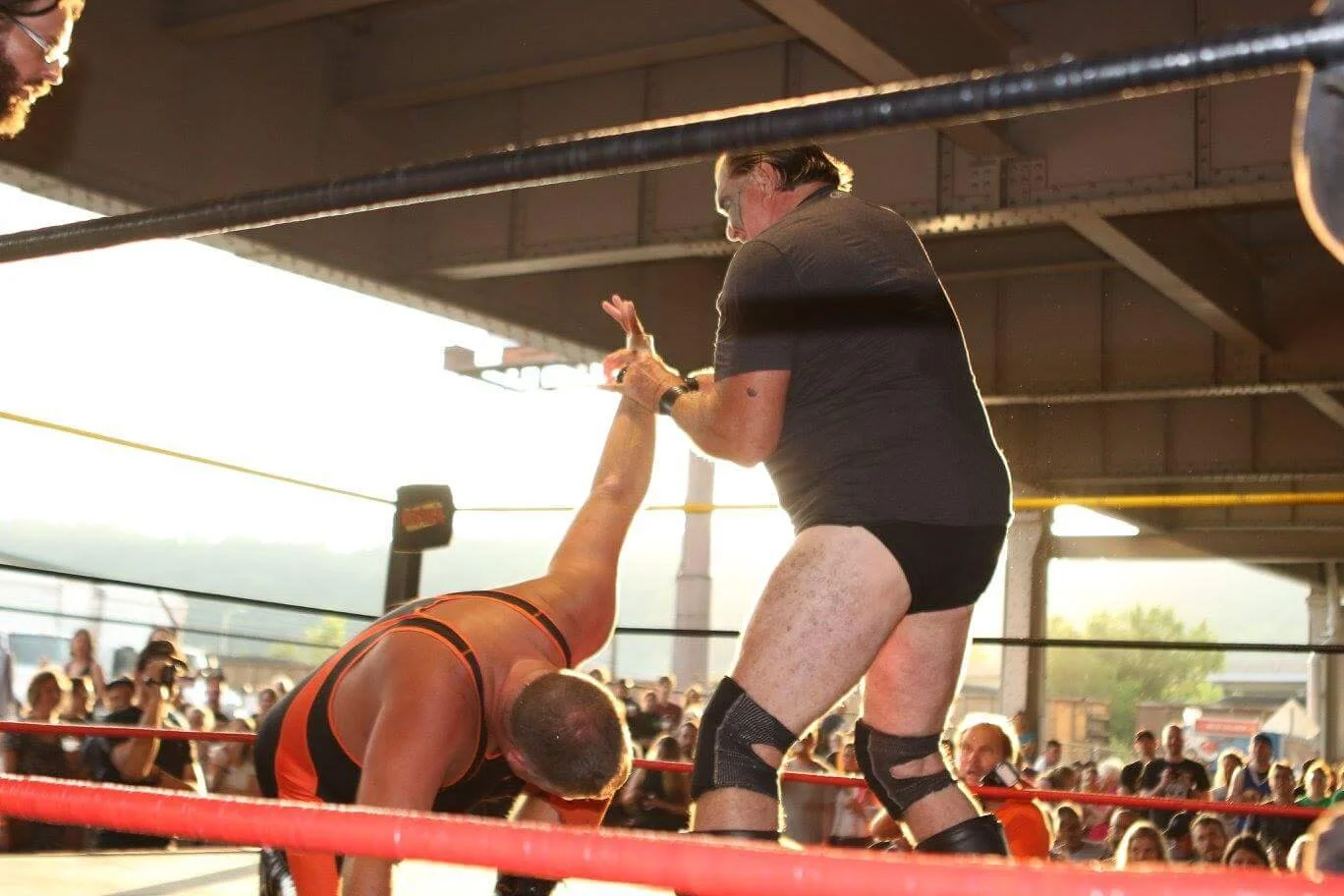
"Demolition Ax" Bill Eadie putting a wrist lock on Shawn Blanchard at Brawl Under The Bridge III. Photo by Brian Keegan.

"Demolition Ax" Bill Eadie putting a wrist lock on Shawn Blanchard at Brawl Under The Bridge III. Photo by Brian Keegan.

Frank Cunniff, a graphic designer for Blue Dust in Homestead, grew up a fan of professional wrestling despite it being banned in his house.

“I love going to [independent wrestling] shows, the live shows are really what I think hooks people to wrestling”.

A Polish Hill resident, he attended Keystone State Wrestling Alliance (KSWA) shows at the Lawrenceville Spirit Hall, and what won him over wasn’t just their wrestling, but their fan appreciation.

“They took time to meet with fans and talk about wrestling or take pictures, things that build a strong connection to their product,” said Cunniff. “I like to think anyway, that’s the way we handle business at Blue Dust.”

Blue Dust held two annual events outdoors under the Homestead Grays Bridge, Pumpkin Fest, and Oyster Fest, Frank had an idea of hosting professional wrestling instead of the usual music acts those events host instead.

When he pitched the idea to the KSWA, they didn’t hesitate to accept, Brawl Under the Bridge was born.

Since the first event in 2015, the event has evolved into the KSWA’s 2nd biggest event, behind FanFest held annually in December.

The Wrestling Ring underneath the Homestead Gray’s Bridge at Brawl Under The Bridge III July 22nd, 2017. Photo by Brian Keegan.

The Wrestling Ring underneath the Homestead Gray’s Bridge at Brawl Under The Bridge III July 22nd, 2017. Photo by Brian Keegan.

Battle Under The Bridge IV will return to the Gray’s Bridge on Saturday July 21st.

“Homestead is like Lawrenceville, there’s a lot of community involvement,” said “Trapper” Tom Leturgey, Ring Announcer for KSWA. “They love having us here and we want to come back every year”.

One of the KSWA’s biggest supporters in Homestead is Betty Esper. She’s attended every event in Homestead and has been big parts of their shows.

“Last year, she rode on the bike of one of our wrestlers”, said Leturgey. “She’s a great personality and friend to us, getting on a Harley at 84 years old and didn’t bat an eye”.

KSWA’s shows are unique in today’s independent wrestling circuit. They have an old-school feel, reminiscent of studio wrestling shows in the 70’s and 80’s.

“Trapper” Tom Leturgey addresses the crowd at Brawl Under The Bridge III. Photo by Brian Keegan.

“Trapper” Tom Leturgey addresses the crowd at Brawl Under The Bridge III. Photo by Brian Keegan.

“We have the blessing of a lot of old-school wrestlers around the area,” said Shawn Blanchard, a 20-year veteran of professional wrestling and one of the co-founders of KSWA.

Brawl Under the Bridge has been an event where the old-school wrestlers get their chance to both introduce and reintroduce themselves to fans living in Homestead. In 2016, Nikolai Volkoff, a former WWE Tag Team Champion returned for a tag match in the second annual event.

Last year’s event had Blanchard battle former WWE Tag Team Champion “Demolition Ax”, Bill Eadie in his last singles match. The two had been rivals for the decade prior in KSWA, as Blanchard tagged with Lou Martin against Eadie and Barry Darsow known as “Demolition Smash”.

Eadie and Darsow were a part of the legendary WWE tag team Demolition in the late 80’s and early 90’s.

Blanchard was a part of Demolition’s last tag team match and considers it an honor to help Eadie, a native of Brownsville, finish his singles career where it started, in Pittsburgh.

“People ask me all the time who were my favorite wrestlers were, and they were Ric Flair, Harley Race, and Bill Eadie,” said Blanchard. “It was a special moment to have the respect of [Eadie and Darsow].

“Demolition Ax” Bill Eadie putting a wrist lock on Shawn Blanchard at Brawl Under The Bridge III. Photo by Brian Keegan.

“Demolition Ax” Bill Eadie putting a wrist lock on Shawn Blanchard at Brawl Under The Bridge III. Photo by Brian Keegan.

Eadie defeated Blanchard for the annual Brawl Under The Bridge Championship, which he vacated in August.

Brawl Under The Bridge IV will have WWE Hall of Famers The Rock n’ Roll Express, Robert Gibson and Ricky Morton will return to the KSWA after their first appearance at FanFest last December.

“For me to introduce them was really cool”, said Leturgey. “The place went berserk, and we expect it to happen again”.

Up and coming talent are also expected to make their Brawl Under The Bridge debuts.

Max Petrunya, 33, was just starting his journey when the first Brawl Under The Bridge happened. He attended the event and knew he had to be here.

“It was a goal of mine to work this event when I began my career”, said Petrunya, of Stanton Heights. “To do it three years in, working with the wonderful people of this organization, it’s a dream come true”.

Petrunya is an attorney at Robert Pierce and Associates and is an Adjunct Professor at Duquesne University. When he’s in the ring, he’s known as “The Gavel” David Lawless, Esq.

“My character is based on the perception of lawyers and the worst qualities of one,” said Petrunya. “It’s a natural heel character, I get a lot of heat with fans and I call them morons.”

He just missed out on Brawl Under The Bridge III last year wrestling a match against KSWA Heavyweight Champion Mitch Napier in June. He won a contract at KSWA’s Battle Bowl, with the opportunity to cash in on the championship at any time.

“The opportunities to meet people and interact outside work has been unbelievable,” said Petrunya. “As I trained the goal was to get one match, that turned into to two, three, and more”.

Another wrestler making his debut is Sam Adonis, a well-traveled wrestler from Monroeville. He has wrestled in places like Great Britain and Mexico with Consejo Mundial de Lucha Libre (CMLL), where his gimmick as a supporter of President Trump, has given him buzz around the Indies.

“His reputation should bring in some fans that would overlook us”, said Leturgey. “With the five dollar tickets, you can’t beat that”.

Brawl Under The Bridge III brought 600 fans under the Homestead Grays Bridge, there have been expectations upward to 1000 for this year’s event.

Tickets are five dollars and local food trucks and brews on tap. The first bell is at 7 PM.

The Rock N Roll Express will take on the VIPs (Blanchard and Martin) and there will be a 9-Man Ladder Match for the vacant Brawl Under The Bridge Championship.

“When you come out to a KSWA event with your money, we will bust our ass to entertain you”, said Blanchard. “All it takes is one show, you’ll be back over and over again”.

The Toxic 10 - Pollution in Pittsburgh

Photos by Tyler Polk

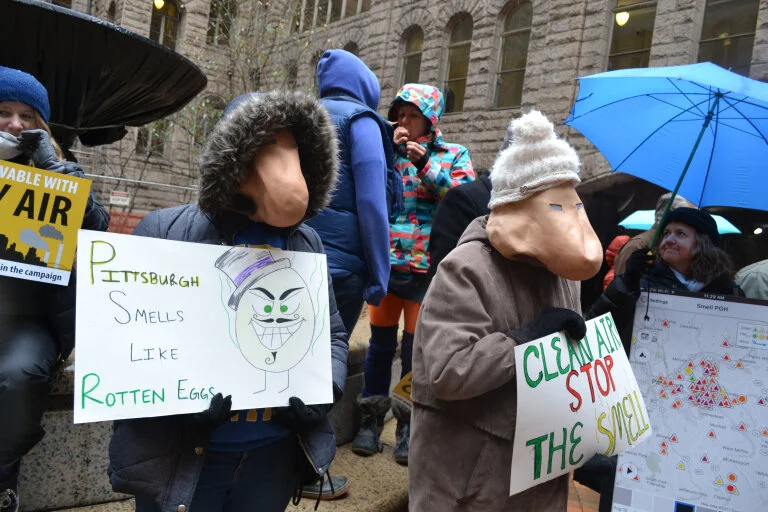
Two people wearing nose masks at the Clean Air Rally on March 20, 2018.

Two people wearing nose masks at the Clean Air Rally on March 20, 2018.

Allegheny County Air Has Improved, But It Is Still Mired In Major Problems

Since moving to Natrona Heights, Donna Frederick, says she has had to wash her car at least three times a week to remove dust since moving across the street from one of the region’s worst polluters.

Marti Blake, a resident of Springdale says coal dust comes into her house from the toxic Cheswick Generating Station even with her windows closed.

These two people all live next to facilities listed in the Toxic 10, a list of the ten most toxic air polluters in Allegheny County. The periodic list shows while air is better in this region after the closure of many steel mills and other polluters, it remains among the worst in America.

The first Toxic 10 list was released in 2015 by PennEnvironment and it used information from 2013 and 2014 to compile the rankings. The second toxic 10 report was released in February, using data from 2016 to report on the problem. You can find the latest report at toxicten.org.

“The reaction was really strong, but the Allegheny County Health Department and the facilities were not so much a fan of the report,” said Zachary Barber, PennEnvironment’s Western Pennsylvania Field Organizer.

“There’s a lot of groups doing air quality work in Pittsburgh, but this was the first time someone provided a roadmap what the pollution landscape looks like”.

“We appreciate PennEnvironment’s commentary regarding air quality in our county. It is important to note that some releases of toxins are allowed under EPA standards, and they are not considered violations,” said Karen Hacker, Director of the Allegheny County Health Department, in a February statement.

Self-Reported Data

Zachary Barber of Penn Environment at the Clean Air Rally on March 20th, 2018..jpg
Zachary Barber from Penn Environment, talking to people who attended the rally for clean air on March 20th, 2018.

Zachary Barber from Penn Environment, talking to people who attended the rally for clean air on March 20th, 2018.

The Toxic 10 is built using databases from the U.S. Environmental Protection Agency (EPA). These databases use self-reported data on what toxins were released, how much in pure tonnage, and how bad a chemical is.

“We looked at how much they put out multiplied by how bad it is to get the toxicity score”, said Barber. “We looked through each facility for everything they put out and added all together to get the overall score for the facility.”

One in three of the 1.2 million people living in Allegheny County live within three miles of the facilities listed in the 2015 report and Barber says that there are similar numbers for the newest Toxic 10 report.

“They see, smell, and taste what’s in the air and understand the entire range of issues, from the quality of living and health to property impacts,” said Barber.

Pollution in Natrona Heights

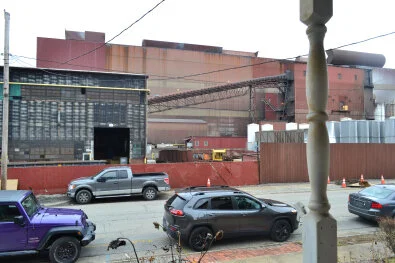
A sign hanging up outside Donna Frederick of Natrona Heights house. Her house is located across the street from ATI Flat Rolled Products – Brackenridge..jpg
A sign hanging up outside Donna Frederick of Natrona Heights house. Her house is located across the street from ATI Flat Rolled Products – Brackenridge.

A sign hanging up outside Donna Frederick of Natrona Heights house. Her house is located across the street from ATI Flat Rolled Products – Brackenridge.

When Donna Frederick of Natrona Heights bought her house in 2007, she figured she would rather live next to the noise of the steel mill than next to drug dealers she had lived close to in the past.

“Through the years I found out that, it would be better to live next to drug dealers, than live next to ATI,” she said.

Frederick has lived in Natrona Heights for ten years, right across the street of ATI Flat Rolled Products, also known as Allegheny Ludlum. The facility was ranked number two on the latest Toxic 10 report.

The Toxic 10 report found Chromium, Cobalt, Hydrogen Flouride, Lead, Manganese, and Nickel compounds coming from the plant. These substances are on the EPA’s list of hazardous air pollutants and are suspected to cause cancer and other health effects.

“We take our responsibility to the communities in which we operate very seriously, including those in Western Pennsylvania,” said Scott Minder, a spokesperson for ATI. “We now have the best available pollution control equipment installed on our Brackenridge HRPF and melt shop facilities.”

Donna Frederick and her husband, Albert, holding the sign and wearing face masks.

Donna Frederick and her husband, Albert, holding the sign and wearing face masks.

“I’ve taken multiple pictures and videos [of the results from the facility’s emissions],” said Frederick. “I’ve had GASP (Group Against Smog and Pollution), take samples of my soil and red residue in my bird bath”.

Recently, Frederick had samples tested from her soil by ALS Environmental, the report found amounts of mercury, arsenic, barium, cadmium, chromium, and lead. These are two hazardous air pollutants according to the EPA.

“We have a swimming pool, and because of the residue getting into the filter, we have to clean that every day,” said Frederick.

Living next to the plant has left her house covered in a white ash-like residue, and the smells of rotten eggs, wires burning makes it hard for her to sit out her porch.

“It’s sad that you can’t sit on your porch and have coffee unless you want your lungs to hurt,” said Fredrick. “This area is known for rentals, so people would buy the houses not knowing [about the pollution]”.

Her neighbor, Rebecca Miller, said the smells forced her to leave her house on two occasions.

“The first time, it made me dizzy, I went shopping and came back home and I really noticed it”, said Miller. “Another time it was a burning feeling in my throat and my eyes. I smell it often, but it’s never been like those two times, but it’s still strong.”

According to the Allegheny County Title V Operating Permit Status Report, Allegheny Ludlum has never been issued a Title V permit in its history.

A Title V permit is required by major sources of pollution and certain facilities for these sources. The permits are enforced federally and can add additional requirements to facilities such as emissions fees and compliance reviews.

According to a spokesperson from the Allegheny County Health Department, the facility was in the draft permit stage and found new information about emissions they were not aware of and have made new limits since then. Currently, the Health Department is reviewing comments from a public meeting from December 19th, 2017.

Pollution in Springdale

Randy Francisco (left) and Marti Blake (right) at the Clean Air Rally on March 20th, 2018.

Randy Francisco (left) and Marti Blake (right) at the Clean Air Rally on March 20th, 2018.

After selling her house in the North Hills in 1990, Marti Blake had two weeks to find a house for her and her two children, then ages three and six. She moved into her house in Springdale across the street from the Cheswick Generation Station, a coal-fired power plant.

Penn Environment’s Toxic 10 list ranked the plant as the number one Industrial air polluter in Allegheny County. The report found Arsenic, Chromium, Dioxin, Hydrochloric Acid, Hydrogen Flouride, Lead, Manganese, Mercury and Nickel compounds in its emissions.

“The air surrounding NRG’s Cheswick Generation Station meets the requirements and emissions from Cheswick are far below its permit limits and is doing much better than its required to do under its current Title V Air permit,” said David Gaier, a spokesperson for NRG.

The view outside Marti Blake’s house in Springdale. This the stacker (left) and the scrubber (right) of the Cheswick Generation Station.

The view outside Marti Blake’s house in Springdale. This the stacker (left) and the scrubber (right) of the Cheswick Generation Station.

“My mother told me, Marti, you’d better get out of there or you’re going to get cancer,” said Blake. “My mother was very smart, but at the time, I had nowhere to go.”
Marti now has asthma and must take an allergy shot every four days. Four years ago she was diagnosed with Melanoma.

While there is no medical relationship known between health and the plant, according to a 2013 study from the University of Pittsburgh Graduate School of Public Health, Allegheny County is in the top 2 percent of cancer rate in the United States.

“I had to have surgery, on my arm, and had lymph nodes removed,” said Blake. I have to go to a dermatologist to get a full body scan every six months to make sure nothing else is popping up.

Coal dust from the coal plant, comes into her home, even when the windows are closed. She cleans her house every spring and one year, it went from bright sunlight to darkness for five minutes. A man who was across the street watching her apologized for the coal dust cloud ruining her work.

“He says, that came from the plant,” said Blake. “I’m so sorry. I’ve been watching you, you’ve been working so hard all day and washing the building down, and then this happened.”

Blake has photos of the soot from her property from other instances of coal dust on her property, and pieces of the paper towel she used to clean her property.

She created her own air quality activism group for Springdale residents called Citizens Against Pollution. She would go canvassing or campaigning around the neighborhood, but the group has since disbanded.

Blake now volunteers for the Sierra Club and presented the evidence of coal dust on her property during the public hearing for the new permit for the Cheswick Generating Station in August 2016.

Residents concerned with air quality and people who work for the industrial facility presented their opinions on how the new permit should regulate emissions.
“There had to be over 100 and some people there,” said Blake.

Focus on the Mon Valley

Mark Dixon, setting up his camera equipment to record the Clean Air Rally on March 20th, 2018.

Mark Dixon, setting up his camera equipment to record the Clean Air Rally on March 20th, 2018.

Since moving to Pittsburgh in 2006, filmmaker Mark Dixon always had a creeping awareness of the stench that comes from air pollution. He would jog around Highland Park where he used to live.

“I smelled weird smells, it grew so frequent and I was frustrated by it,” said Dixon. “I didn’t want to jog by an area that smelled of sooty stench”.

His awareness wasn’t fully piqued until he crowdfunded a journey to cover the Paris Climate Agreement as a citizen journalist. He was concerned about climate change and he wanted to find something local.

He chose air quality as his subject because of a March 2016 Consent Order and Agreement (COA) between the Allegheny County Health Department and U.S Steel on air quality violations from the Clairton Coke Works, the number three facility ranked on the Toxic 10 List.

U.S. Steel did not respond to requests for a comment. According to the coke works compliance report, the facility has so far met the requirements from the March 2016 Consent Agreement. They fixed three coke oven batteries and voluntarily added another battery to its compliance plan in June 2017.

Mark Dixon, recording the Clean Air Rally on March 20th, 2018.

Mark Dixon, recording the Clean Air Rally on March 20th, 2018.

There were previous COAs in 2007, 2008, 2011 and 2014. U. S. Steel completed the corrective actions and supplemental environmental project and paid the civil penalty required by the 2007 COA.

The consent agreement stated that U.S. Steel must inspect and fix its coke ovens and come into compliance within 3 years. The facility paid the $3,948,000 of the previous penalties accrued since 2009 and would pay the final $25,000 of the assessed fines.

The agreement came after PennFuture announced an intent to sue U.S Steel for 6,700 violations from January 1st, 2012 to May 31st, 2015. They claimed the nation’s largest coke producer was emitting pollutants that negatively affect health.

Since then, PennFuture announced their “Toxic Neighbor” plan that targets the Clairton Coke Works. The announcement of the consent agreement disappointed Dixon.

“It felt like a breach of public trust and made me deeply question the purpose of the Health Department,” said Dixon. “I decided to start this documentary to get to the bottom of why air quality is a persistent issue in Pittsburgh and immerse myself in the problems and potential solutions”.

That documentary is tentatively called Inversion: The Unfinished Business of Pittsburgh’s Air. His focus for the film is in Mon Valley, close to his home in Squirrel Hill South. The Edgar Thomson Works and the Clairton Coke Works are in that area.

“I’ve been trying all types of things since then,” said Dixon. “From buying and testing citizen science and low-cost monitors to measure particles and volatile organic compounds (VOCs), talking to air quality community members about the challenges, calling the Health Department to talk about air quality problems and ask them questions”.

A common question he has asked is; Where the smell is coming from? Frustrated by being unable to get an answer he decided to use his time and money to research.

“It’s coming from the South or South East. It’s somewhere in between Braddock and Edgar Thomson Mill and the Clairton Coke Works. I can’t pin it down with any factual basis.”
Dixon has tracked weather data, inversion data, and used air quality technology like volatile organic compound (VOC) monitors and particle sensors in his home to find where the smells are coming from.

“I wish that the Health Department would do that work,” said Dixon. “It’s very frustrating that this has not been solved yet, they have worked on this with many more researchers for decades longer than I have”.

“We do know the main sources that are responsible; but since there are also other sources that contribute, we are exploring various means to better understand how much each source emits,” said Ryan Scarpino, Public Health Officer for the Allegheny County Health Department.

Daily White Smoke

Cheryl Hurt checking her Speck Air Quality Monitor, from the CMU Create Lab..jpg
Emissions from the Clairton Coke Works seen from outside Cheryl Hurt’s house.Cheryl Hurt checking her Speck Air Quality Monitor, from the CMU Create Lab.

Emissions from the Clairton Coke Works seen from outside Cheryl Hurt’s house.

Cheryl Hurt checking her Speck Air Quality Monitor, from the CMU Create Lab.

“That’s what bothers me. That they release this every day,” said Cheryl Hurt. As she looks out the window as the Clairton Coke Works releases white smoke into the air. “I know how harmful it is for us.”

Hurt runs a daycare out of her home in Clairton, a few streets up from the Clairton Coke Works. She understands that emissions today are different from when she was younger.

“The particles that are there now is more harmful now than what we grew up with, there’s an odor that you can smell,” said Hurt. “People who aren’t from Clairton notice the smell, we are used to it”.

A 2018 study from the Surveillance and Tracking of Asthma in our Region’s Schoolchildren (STARS) on children from Clairton Elementary School, found that 18.2 percent of children suffer from Asthma, nearly doubling the rate reported by the Commonwealth of Pennsylvania.

Cheryl’s Speck Air Quality meter, reading good air quality in Clairton for that day.

Cheryl’s Speck Air Quality meter, reading good air quality in Clairton for that day.

Hurt is aware of the effects and long before reports on the children’s asthma problems were reported, she was trying to mitigate the risk with her Speck Air Quality Meter that she got from the local library.

The device detects and calculates the amount of fine particulate matter in the air. The monitor gives the number of particles in the air, along with a corresponding color, green is good, and red or orange signals poor air quality.

“When it says that it’s bad or moderate, I keep the kids inside,” said Hurt. “I don’t open my windows, it’s usually bad [pollution] outside even when it’s a good day”.

Backyard Woes

John Macus in his backyard in Jefferson Hills.

John Macus in his backyard in Jefferson Hills.

After a yearlong search for a new house, John Macus and his ex-fiancé purchased their home in Jefferson Hills in 2008 because of the big backyard that came with his house.

“We purchased the home during the recession and he plant was also in the recession,” said Macus. “At the time there wasn’t as much emissions coming from there [the coke works] that time, so there was no way we could see the emissions coming.”

Within the first month of living there, the plant began running again. Macus said he and his ex-fiancé would wake up with shortness of breath, headaches, and migraines.

“When you go outside and ask what’s that smell and how is it getting in the house and the windows are closed,” questioned Macus. “Then you drive by the place and figure out where it comes from, you wonder what did we move next to”?

Macus prides himself on fitness, he runs 15 miles with a 70-pound bag to train for one of his hobbies, Spartan races. The feeling of that training pails in comparison to the symptoms he gets from pollution.

“On the worst days, I feel sick, nauseous, migraines, you feel sluggish, and gasp for air,” said Macus. “. I get winded [from the training], but not like how the pollution gets me.”
He tried calling the Clairton Coke Works to talk about his issues with pollution, the calls would be so frequent, that they started referring him to the emergency services.

“Half of Jefferson Hills Fire Department came once, they brought EMTs and trucks up”, said Macus.

The firefighters came into his house and checked the property with a carbon dioxide detector, instead of one that registers benzene and sulfur.

“The two firefighters stood on my porch, one said he couldn’t smell it, and another said he gets similar smells in his house in Elizabeth”, said Macus.

He realized contacting the Allegheny County Health Department could help him more, so after a year in his house he started contacting them.

They sent him an air quality monitor, and he went out on his porch the next morning and found the evidence he was looking for.

“There was reports of traceable amounts of Benzene and Taurine on his back porch,” said Macus. “There should not be traceable amounts of these chemicals on your porch at 6 A.M.”.

He was frustrated when he reported back to the Health Department what he found. Despite the evidence he found, they couldn’t pinpoint the source.

“There is not a thing around that comes close to it”, said Macus. “That is a giant plant, there are 8-9 giant stacks that do what 10,000-20,000 automobiles don’t even do in one day, it’s so easy to pinpoint.”

John Macus on his porch, looking at his backyard..

John Macus on his porch, looking at his backyard..

“We are continually working with partners and organizations to determine if there is any action that we may be able to take,” said Scarpino. “This is a complicated issue and the question is not one that is easily answerable”.

Macus had attended meetings with groups like PennFuture, GASP, and others, but he wasn’t there for talking, he wanted action.

Along with Cheryl Hurt, he filed a class action lawsuit in May 2017 against U.S. Steel in Allegheny County Common Pleas Court.

They alleged that emissions from the Clairton Plant have affected plaintiffs and members of the putative class of nearby homeowners, allegedly interfering with the use and enjoyment of their properties and causing unspecified property damages.

“It felt like real change was coming when the paperwork was coming through,” said Macus.
The case was filed for consolidation with another case against U.S. Steel, filed in June 2017 by Cindy Ross, a resident from Clairton.

One day, he got a call from one of the attorneys who was representing him, saying that another group of lawyers in the case were not using his complaints.

“When he called me and said [his part of the lawsuit] was falling through, it was heartbreaking.”

Penn’s Future

A sign outside Marti Blake’s house in Springdale, created by the Sierra Club.

A sign outside Marti Blake’s house in Springdale, created by the Sierra Club.

The American Lung Association gave the Pittsburgh Metropolitan Area an F rating for air quality and said the air quality in Pittsburgh is not improving on April 18th.

In January, the Allegheny County Health Department’s Air Quality program updated its civil penalty policy so that higher penalties can be levied for violations.

They hope that the higher penalties will act as a deterrent for companies that violate clean air standards and lead to overall improvements in air quality.

Donna Frederick, a Natrona Heights resident, said she only has one request for facilities and organizations involved in the air quality battle.

“I just want to live and want my grandchildren to be able to breathe clean air! It’s a reasonable request.”

Part of a 2-part series.


Family First: Former Northsiders Bring Boxing and Family Values to North Hills Gym

Josh Mook sparring with Brody White, a common sparring partner. Photo by Ty Polk.

Josh Mook sparring with Brody White, a common sparring partner. Photo by Ty Polk.

AMIDST A ROUGH CHILDHOOD, JOSH AND JESSEE MOOK FOUND SOLACE THROUGH BOXING AND ARE NOW HELPING THEIR ADOPTED FATHER PAY IT FORWARD AT NORTH HILLS BOXING GYM.

Jack Mook, 48, a boxing coach, military veteran and former police officer in the City of Pittsburgh for 25 years believes, “a child should be a child, not a survivor.”

After years of training and sparring around Pittsburgh, Jack was asked by George “Geo” Heinlein and Doug Seskey, two coaches at the Steel City Boxing Gym in Spring Hill to teach underprivileged youth how to box.

“They believed I knew how to communicate with kids,” said Mook. “They saw me as an asset to the gym”.

In 2008, Mook met two young Northsiders, Josh and Jessee. The two brothers had been moving in and out of homes throughout Northview Heights and Spring Hill, living with different family members and legal guardians every month. They discovered a sanctuary at Steel City Boxing.

“Those two hours a day kept [us] out of a lot of trouble,” said Josh. “I knew I could go there and forget about everything else.”

Mook took the boys under his wing, began honing Josh’s natural potential for boxing and a bond was forged between the trio.

“He had a natural talent and he had a movement that would work in the ring,” said Jack. “He’s a technician in the ring, intelligent in the ring and sets up his counter punches well.”

One day, the two stopped showing up at Steel City Boxing.

Steel City Boxing gym’s motto is painted on the wall. Photo by Neil Strebig.

Steel City Boxing gym’s motto is painted on the wall. Photo by Neil Strebig.

“One week turned into two and then three, I got worried,” said Jack. “Josh was dedicated. It was concerning”.

Mook used his connections from around the city to find out what happened to the two brothers.

According to a September 2014 story by the Tribune-Review, the boys’ biological parents suffered from drug addictions, the two were in and out of foster homes and after one of their guardians was arrested, Mook decided to intervene.

In 2013, Mook became the brothers’ foster parent. In 2014, he officially adopted the pair, a story that gathered national attention and is reportedly in the works for a movie deal.

His belief that a “child should be a child, not a survivor,” was a strong contributor towards his adoption of Josh and Jessee.

“I was trying to get Jack’s involvement all along,” said Josh. “I’m glad to be part of a regular family, a regular life.”

With a stable home life, the Mook brothers were finally able to live as children, not just survivors.

Jessee, now 15, began focusing on school more, he’s routinely receiving As and Bs on report cards. He even won the Golden Gloves tournament in his first chance.

Josh, now 18, has won four consecutive Golden Gloves tournaments, proving Jack’s theories of good home life, nutrition, and a feeling of security can do wonders for a child.

Formerly of Brighton Heights, the Mook family now resides in Ross Township where the now-retired Jack Mook, opened Jack’s Boxing Gym. The North Hills gym may boast the most wins of any Western Pennsylvania boxing gym, but it is the family component that makes the gym special. Jack, Josh and Jack’s wife, Mary all work as trainers at the facility.

“Some of these kids getting their first wins gave me the same feeling when I got mine,” said Josh. “I brought myself back to the basics and now I see everything he taught me.”

His sparring partner, Brody White, 16, enjoys training and learning from them.

Josh Mook coaching Brody White through a boxing drill. Photo by Ty Polk

Josh Mook coaching Brody White through a boxing drill. Photo by Ty Polk

“I became best friends with him through boxing,” said White. “It’s awesome coming to work out with him every day and learn from him and Jack.”

These words make Jack proud. For him finally seeing Josh understand and sharing the science of boxing is priceless.

“It’s awesome he’s getting this. I learned from pros, that told me what I needed to continue,” said Jack. “It feels like it’s God’s plan.”

Josh’s next fight is a rematch against Jerome Baxter, who won this year’s Golden Gloves tournament, defeating Josh by referee stoppage in the second round.

Josh says the defeat was more of a mental block from Baxter.

“He was the first person to make me quit in the ring,” said Josh. “But, it made me the best boxer I’ve ever been. It’s changed the way I look at fighting and coaching.”

Josh will have a chance to avenge his loss on Friday, May 25 during the Pro-Am Boxing Night event at The Grand Hall in The Priory. The three round, 152lb bout will be Josh’s final fight before he leaves for basic training with the Army in July.

Michael Manna, an assistant coach at Jack’s Boxing Gym, says he’ll be sad to see him go.

“I’m going to miss him. It will suck to see him go,” said Manna.

Josh plans on becoming a cavalry scout in the service but says he isn’t finished with boxing quite yet. His goal is to compete for the U.S. Army boxing team and win gold at the 2020 Olympic Games in Tokyo.

“I’ve had this idea of joining the military since I was 6 years old,” said Josh. “I was inspired by Geo [Heinlein], who was a Marine, but joining the Army like Jack, was the best decision.”

Josh is also thinking of turning pro after he competes in the Olympics.

What’s his father think?

“Wherever they want to go, I’ll help them along the way,” said Jack. “They will be successful”.

Published in the Northside Chronicle


Steel City Yellow Jackets Hope To Create A Buzz For Pro Basketball In Pittsburgh

The Steel City Yellow Jackets put their hands in at the end of a pre-season practice on Sunday, Sept. 29, 2017.TYLER POLK / 90.5 WESA

The Steel City Yellow Jackets put their hands in at the end of a pre-season practice on Sunday, Sept. 29, 2017.

TYLER POLK / 90.5 WESA

Tyler Polk Steel City Yellow Jackets

When Averill “Ace” Pippens received a call about becoming a head coach and general manager of a semi-professional basketball team, he had no hesitation.

“It was a no-brainer,” said Pippens.

Pippens, a coach of local basketball teams for 14 years, said the call came from a former player, about a new team called the Steel City Yellow Jackets.

At the beginning of their inaugural season in 2014, the team was thriving on the court, but struggling financially and threatening to fold. Pippens said he sat down with the team and asked them if they wanted were willing to finish the season without a paycheck. All of the players agreed, telling Pippens they weren’t in it for the money.

Steel City Yellow Jackets Head Coach and General Manager Averill "Ace" Pippens with the American Basketball Association’s game ball on Sunday, Sept. 29, 2017.CREDIT TYLER POLK / 90.5 WESA

Steel City Yellow Jackets Head Coach and General Manager Averill "Ace" Pippens with the American Basketball Association’s game ball on Sunday, Sept. 29, 2017.

CREDIT TYLER POLK / 90.5 WESA

“It let me know that we had something special, so I didn’t want to let it go,” said Pippens. “The purpose was for these young men to have an outlet and an opportunity to play basketball after college.”

The team made the playoffs that year, and have made an appearance every season since.

Pittsburgh has had a complicated history with basketball teams. Its professional teams, the Pittsburgh Rens, the Pittsburgh Pipers and the Pittsburgh Condors, never lasted long. Since the 1970s, five semi-professional teams have folded.

All teams struggled with finances in an already saturated Pittsburgh sports market.

Being a semi-professional team isn't easy, either. The American Basketball Association has 100 teams intending to play at least 30 games a season, but fewer than half have the funds to consistently complete their season.

James Sutton, a  McKeesport native and assistant coach of the team, said he understands the struggles of semi-pro basketball in Pittsburgh, having played for the most recent failed franchises, the Xplosion and the Phantoms.

Pittsburgh has had major league basketball teams before, such as the Pittsburgh Pipers, but they didn't work out in the long run.CREDIT PHOTO COURTESY OF THE HEINZ HISTORY CENTER LIBRARY AND ARCHIVES

Pittsburgh has had major league basketball teams before, such as the Pittsburgh Pipers, but they didn't work out in the long run.

CREDIT PHOTO COURTESY OF THE HEINZ HISTORY CENTER LIBRARY AND ARCHIVES

“Every [team] has their ups and downs, it is what is,” said Sutton. “It’s a part of business, you go to see how long you can go, and when the well dries up you move on.”

Sutton said he gives advice to the entire team, including his younger brother Matt, a small forward on the Yellow Jackets, about handling life on a semi-professional team.

“You got to work on your game and make sure you stay competitive,” said Sutton. “You need to be professional like any other job you work.”

While the league shares the name of the original ABA, whose first champions where the Pittsburgh Pipers in 1968, the new ABA, founded in 2000, bares little similarity outside of using the iconic red-white-and-blue ball, the league is known for.

To make the game faster and more entertaining for fans, the league has altered its rules from the traditional NBA-style of play. For example, the ABA uses a “three, ten and out” rule for overtime. The teams play a three minute period of overtime, and if the game is still tied, they play until the winning team scores 10 points.

Point Guard Khari Bess (right) practices his free throws with Assistant Coach James Sutton (left). Sept. 29., 2017CREDIT TYLER POLK / 90.5 WESA

Point Guard Khari Bess (right) practices his free throws with Assistant Coach James Sutton (left). Sept. 29., 2017

CREDIT TYLER POLK / 90.5 WESA

Gerald Brooks, a power forward for the Yellow Jackets, said another change requires players to make it to the offensive side of the court in a quick seven seconds.

“It’s lightning fast, there’s no games, no lollygagging,” said Brooks. “That’s why we run and train so hard in practice, because the game is so fast, scores can be over 120 points every game.”

Brooks calls himself one of the “dogs” due to his play style as an undersized big man. At 6'5" he finds himself going against traditionally taller players at the position of power forward and center. But he said he’s used to tough competition. He’s played alongside former Pitt standout Dejuan Blair at Schenley High School, and with similar undersized bigs at Indiana University of Pennsylvania, Slippery Rock, and on a professional team in Ecuador.

“We’ve always been the leading rebounders and the hearts of the team, it’s what I bring to the team every day,” said Brooks.

Brooks said the smaller size of the team has allowed him to gain experience in operations off the court, like helping secure sponsorships. He’s proud to be a part of a team coached by Pippens, who he said dedicates himself to the community even when he’s not coaching.  

Pippens is the Executive Director of A Giving Heart Community Center in Beltzhoover, where the Yellow Jackets play. His teammates explain his commitment to the community is also a big reason they love playing on the team. 

“Look at what’s going on, and what he does for the community. Nobody owns their own basketball court,” said Brooks.

Co-captain Antonio "Tone Red" Reddic said he's proud of what the team's been able to accomplish in Pittsburgh. While leading the players on the team, he's earned numerous honors from his teammates and a nomination to the ABA All Star Game last year. His biggest goal, echoed by many of the other Yellow Jackets, is to capture the ABA championship.

“That’s the next level for us,” said Reddic. “We’ve shown we can compete with the best, and beat the best. We’ve shown we can make the playoffs, the next step is to bring home the gold.”

The Yellow Jackets are currently 3-1 in their season, and are hosting the ABA All Star Game in April 2018.

Night of Fights at Carnegie Music Hall goes to Round 2

Llewelyn McClammy throws a punch at Leemont Johnson in a sparring session. Photo by Tyler Polk.

Llewelyn McClammy throws a punch at Leemont Johnson in a sparring session. Photo by Tyler Polk.

Pro Boxing returns to the Carnegie Music Hall of Homestead on Nov. 4.

Integrity Fighter Management and the Conn-Greb Boxing Gym present the event following the first successful pro boxing night held at the venue back in March.

Mike McSorley, a promoter, and trainer at Conn-Greb said they choose to return to the venue because of the historic feel and good sight lines.

“It’s going to be a memorable night,” McSorley said.

McSorley said they are open to other venues, but they would like to cultivate the Music Hall as the next Blue Horizon, a famous fight venue in Philadelphia.

“We want this place to be known as somewhere you can come and see great fights, in a beautiful venue with good sightlines that’s affordable,” said McSorley.

Expect to see more action at the upcoming event that currently has nine bouts scheduled.

The main event of the evening will be a battle between Pittsburgher and undefeated former Golden Gloves champion Gerald Sherrell (7-0 3 KO’s) against Shakeem “The Lion” Hodge (5-0 4 KO’s) from Reading.

Sherrell who boxed in the March event is ready for the spotlight.

“It feels good, it’s an exciting feeling, I’m just ready to go, I’ve seen [Hodge] fight before, he’s decent,” said Sherrell. “I’m ready to put on a show. I hope everyone’s ready for a good show and some good fights.”

His previous fight was in September he defeated his last opponent by technical knockout in the fifth round.

“It felt good, to be back in the ring [after an injury]. I’m gonna keep doing what I’m doing and get ready and stay ready. Hopefully, another blessing will come,” Sherrell said.

His opponent Hodge is no slouch with four victories coming by way of knockout.  His trainer, Lindsay Bates, describes him as a strong, athletic and fearless.

Llewelyn McClammy sparring with Oleg Dovhun. Dovhun will also be competing at the Carnegie Music Hall. Photo by Tyler Polk.

Llewelyn McClammy sparring with Oleg Dovhun. Dovhun will also be competing at the Carnegie Music Hall. Photo by Tyler Polk.

“It’s not the first time we faced a Pittsburgh fighter,” said Bates. “We don’t sleep on anyone, we prepare hard and we train hard.”

Bates knows Shakeem will be ready for this fight.

“I’ve been coaching him for 7 years, he’s relaxed and ready, he knows he needs this fight to boost his career to the next level,” said Bates.

Four boxers will make their professional debuts including Dib “The Wolf” Kaddah from Cleveland and Pittsburgh Golden Gloves Champion, Llewelyn McClammy. McClammy has been itching to get in the ring and is excited to for his pro career to begin in such a historic venue.

“I just wanted to get back to the laboratory and fine tune some things,” said McClammy. “This first pro fight is gonna be a good showcase to see if I’m ready for the pros, Kaddah has a background in MMA, so he’s not gonna be an average push around boxer.”

He’s also excited to be debuting on the same card as “Pretty” Richie Cantolina. Cantolina and McClammy both train with the Pinnacle team.

“He comes in the gym and steps on the gas and doesn’t stop till he gets the results he wants,” said McClammy.

Leemont Johnson (4-0 3 KO’s) from Braddock scored the March 31 card’s only knockout of the night. He’s excited to return to work with Integrity Fight Management against Eric Goven (6-2 3 KO’s) from Germantown, Maryland.

“As boxers, you get the knockout when you don’t look for it,” Johnson said. “Most of my knockouts surprise me when I’m doing my thing. It feels good to get respect from your opponent.”

To describe Amonte “The Magician” Eberhardt (9-0 3 KO’s) in one word is focused.

The Navy Reserve member is soft-spoken outside the ring, but in the ring, he’s all business. He credits the success he’s had to his team.

Lyubomir Pinchuk training with Michael McSorley for his fight on November 4th, at the Carnegie Music Hall. Photo by Tyler Polk

Lyubomir Pinchuk training with Michael McSorley for his fight on November 4th, at the Carnegie Music Hall. Photo by Tyler Polk

“No matter what, every decision that we make, we talk about it first,” said Eberhardt. “Even though I’m the boxer, they know I’m the one who gets in there, but I value their input, there’s no substitute for experience.”

His last fight was against Ugandan champion Charles Mulindwa, and his next fight is against Mexico’s Ulises Jimenez.

“Our game plan is always to go into there and adapt, that’s why I like to put pressure on my opponents,” said Eberhardt. “I felt like especially in my last fight, him being from Uganda and me from the U.S., I felt I had to show off the flag.”

he international fights continue with two Ukrainian fighters who are climbing the ranks of the boxing world Lyubomir “The Demolition Man” Pinchuk (3-0 2KO’s) and Oleg “Ukraine Pitbull” Dovhun (3-0 1KO).

“It’s different training, a different city, it’s something new,” Pinchuk said. “I like Pittsburgh, people here are very friendly, and they are willing to help you.”

The two made their debuts in March and have been the talk of the town.

“It’s been very exciting, more people from Ukraine come to see [Oleg and Lyubomir] fight,” said McSorley. “Lyubomir has been taking out his last couple of opponents with a high knockout ratio, and people said they like the way Oleg brings fury and anger to the ring.”

Oleg’s next opponent in Joseph “Ice” Cole from Marrero, Louisiana.

“It’s been a good adjustment,” said Dovhun. “I miss Ukraine, but I want to be champion, I want to live here for a long time.”

Overall five fighters from March’s boxing event will be in action including Danny Rosenberger from Youngstown, Ohio. Rosenberger (1-3-2) will face Bobby Osterreider (1-0) from Butler.

Health Insurance Open Enrollment Begins Wednesday. Here's What You Need To Know

Ronald Pederson (left) gets help signing up for health insurance from navigator Christian Fattore on March 17, 2014. LIZ REID / 90.5 WESA

Ronald Pederson (left) gets help signing up for health insurance from navigator Christian Fattore on March 17, 2014. LIZ REID / 90.5 WESA

Wednesday is the first day of the open enrollment period for Americans to buy health insurance through the Affordable Care Act for 2018.

About 40,000 Allegheny County residents were enrolled in marketplace plans through the exchanges last year, County Executive Rich Fitzgerald said.

“It has been a tremendous benefit,” said Fitzgerald. “Not just for their physical health and their health security, but also on their financial security, families and where they live.”

Allegheny County Health Department Director Karen Hacker estimated about 8 percent of Allegheny County was uninsured in 2013, about 100,000 people. Today, she said that rate has been halved.

And while health insurance is "absolutely critical," Hacker said, it’s not always easy to set up through the online portal.

“It’s a little challenging to figure out how to navigate the system,” she said.

Hacker reminded people that the federal Navigators program is available again this year to help people sign up. Navigators are available for in-person meetings at community centers, health centers and other locations throughout Southwestern Pennsylvania.

This year’s open enrollment period is half the length of last year’s, running from Nov. 1 to Dec. 15. The federal exchange website will also be down for maintenance on most Sunday mornings.

Helpful Links:

Beaver County Suit Claims Opioid-Related Industries Lied About Drugs' Addictive Qualities

A lawsuit by Beaver County says doctors, pharmarcies and manufacturers of opioids didn't talk enough about how addictive the drug could become.PATRICK SISON / AP

A lawsuit by Beaver County says doctors, pharmarcies and manufacturers of opioids didn't talk enough about how addictive the drug could become.

PATRICK SISON / AP

Beaver County announced Monday it is suing for millions of dollars in damages from opioid manufacturers,  drug distributors and physicians.

The civil suit claims 23 drug companies and doctors led consumers to believe that opioids were not addictive and the county spent taxpayer dollars responding to hundreds of deaths and overdoses.

In 2016, Beaver County saw 102 deaths caused by overdose and 51 deaths have occurred this year, according to OverDoseFreePA, a website that tracks the rate of deaths in the state.

Bob Peirce, an attorney with Robert Peirce and Associates, said the suit covers the deaths of people, the cost of treatment and repeat overdoses.

“Our suit alleges and we have evidence to prove that the drug companies and their doctors deliberately misrepresented the fact that these drugs were addictive,” he said. “In fact, they lied and said they were not addictive.”

The opioid epidemic is affecting all of Pennsylvania including Allegheny County, where 650 people died last year from overdose and 427 people have died so far this year.

Peirce expects more counties around Pennsylvania to take action.

“We have discussed this with at least four or five other counties in western Pennsylvania and I think within the next two weeks you’ll see a number other counties filing a similar lawsuit,” Peirce said.

This is the third suit filed by a county in Pennsylvania. Lackawanna and Delaware counties filed similar suits in September.

The suit is civil, instead of criminal, Peirce said, because legislation protects pharmaceutical companies. 

“If there’s to be a criminal case, it has to be brought to them by the Attorney General,” said Peirce. “One opportunity we have is to go after them civilly. If it costs them billions of dollars, then that’s a way I think they will change.”

Meet The Man Who Digs Through Archives To Document Pittsburgh's Rich Boxing History

Douglas Cavanaugh at the Grave of Harry Greb in Mckee's Rocks. Photo submitted by TIM CONN, PITTSBURGH BOXING: A PICTORIAL HISTORY

Douglas Cavanaugh at the Grave of Harry Greb in Mckee's Rocks. Photo submitted by TIM CONN, PITTSBURGH BOXING: A PICTORIAL HISTORY

Pittsburgh sports fans are familiar with local celebrities like “Mean” Joe Greene, Roberto Clemente and Mario Lemieux, but what about Harry Greb, Billy Conn, and Fritzie Zivic? Although it’s not as popular as football, hockey and baseball, Pittsburgh has a storied boxing history. 

Douglas Cavanaugh, a Burbank, Calif. native, has written about boxing for 24 years. He documents Pittsburgh’s fighting history on his Facebook page, Pittsburgh Boxing: A Pictorial History. He said he is working toward publishing a book based on his research. 

90.5 WESA’s Ty Polk spoke with Cavanaugh about his love for Pittsburgh’s boxing legacy.

Their interview was edited for content and clarity.

TY POLK: You’re a native of California, so what intrigued you to write about Pittsburgh’s fighting history?

DOUGLAS CAVANAUGH: I noticed that a vast number of boxers that I liked were from Pittsburgh. Guys like Billy Conn, Harry Greb, Fritzie Zivic, Sammy Angott and Frank Moran. I wondered what was in the water there. Pittsburgh isn’t a big city compared to fight towns like Chicago or Philadelphia. I also noticed that as I did the research, Pittsburgh was the only town that didn’t have many books on its boxing history. Pittsburgh has largely been overlooked, which is amazing considering how many world champions and top contenders came from there. 

Henry Armstrong (left), former triple boxing champion, climaxed a whirlwind comeback campaign in San Francisco, Oct. 26, 1942 when he scored a 10-round decision over Fritzie Zivic of Pittsburgh, the man who took his title away from him two years ago…

Henry Armstrong (left), former triple boxing champion, climaxed a whirlwind comeback campaign in San Francisco, Oct. 26, 1942 when he scored a 10-round decision over Fritzie Zivic of Pittsburgh, the man who took his title away from him two years ago. Zivic himself has since lost the crown. For the most part the two traded blows at close quarters.

CREDIT ASSOCIATED PRESS

POLK: Were there times you dug through the archives of the Pittsburgh Press and weren’t able to find a certain fight or fighter? Did it ever get frustrating going through all of those incomplete records?

CAVANAUGH: Yes, but it was part of the fun of researching it. I got to dig through these old newspaper archives and find these fights. It was like uncovering a lost civilization. It’s exciting and I enjoy it. What I had to bring to the project, and in turn bring to the people of Pittsburgh was, “Hey here’s your history.” People know about Greene, Lemieux and Clemente. They might have heard the name Harry Greb, but they don’t know about how he’s arguably the greatest pound-for-pound fighter of all time and he’s from Garfield. Greb slaughtered people from middleweight to heavyweight. I believe this something that should be brought to the forefront.

Harry Greb poses on Feb. 21, 1926 CREDIT ASSOCIATED PRESS

Harry Greb poses on Feb. 21, 1926 CREDIT ASSOCIATED PRESS

POLK: Who are your favorite fighters?

CAVANAUGH: Fritzie Zivic was a comedian and so darn funny. He could be on the Pittsburgh nightclub circuit easily. The image everyone has of him is this flat-nose, sneering villain, and I hated the way he looked at first. You immediately want to hate him when you read about his tough reputation and see his picture, but when you read more about him you learn he’s a charming rascal. His opponents loved him and wanted to hang out with him. Fritzie was considered the worst boxer out of his three Olympian brothers, but in the "Golden Age of Pittsburgh Boxing" during the 1920s, he did better than all of them. 

Charley Burley is another fighter I like. Troy Maxson from August Wilson’s Fences was based on him. Wilson grew up across the street from Burley and admired him. In real life, Burley was the opposite of the character, he was gracious, had a practical view on life. He was a great fighter. One fighter he beat handedly in their prime, Archie Moore, said he was, “Slick as lard, and twice as greasy.”

With injuries on his nose and under his eyes, Billy Conn still manages to smile after he was knocked out by champion Joe Louis in the eighth round of their World Heavyweight Championship bout at Yankee Stadium, New York, June 20, 1946. CREDIT ASSOCI…

With injuries on his nose and under his eyes, Billy Conn still manages to smile after he was knocked out by champion Joe Louis in the eighth round of their World Heavyweight Championship bout at Yankee Stadium, New York, June 20, 1946. CREDIT ASSOCIATED PRESS

POLK: Steelers founder Art Rooney was also an acclaimed boxer. How is boxing connected to other sports in Pittsburgh?

CAVANAUGH: Rooney was considered a hot young prospect in the late 1910s, and he qualified for the 1920 Olympics. He was knocking everybody out, he was a killer. However, in the 1920s he decided to pursue other things like baseball and football.

In the 1930s during the Great Depression, Art began financing boxing with Barney McGinley and later created the Rooney-McGinley Boxing Club. It became a big deal and everybody wanted to fight for them because they knew they’d get paid and there was no ego, they were about principle and honesty. Art was the figurehead of boxing in Pittsburgh. For Pittsburgh, boxing was head-to-head with baseball in popularity from the 1920s to 1960s. When Billy Conn would fight, half the Pittsburgh Pirates and Steelers were in the audience. He would invite celebrities to come down to fights. Everybody wanted to be a part of the boxing scene in Pittsburgh. It was a glamorous time.

American Light-Heavyweight Billy Conn, of Pittsburgh, takes a whack at the punching bag in New York on Feb. 7, 1939, as he prepared for a fight against Fred Apostoli, in Manhattan February 10. ASSOCIATED PRESS

American Light-Heavyweight Billy Conn, of Pittsburgh, takes a whack at the punching bag in New York on Feb. 7, 1939, as he prepared for a fight against Fred Apostoli, in Manhattan February 10. ASSOCIATED PRESS

POLK: What do you hear from your followers about your page?

CAVANAUGH:  When I made the page, suddenly people were coming left and right asking if I had heard of their grandpa and exchanging photos and newspaper clips. I’ve had people tell me the page brings them to tears. They say their grandfather was an obscure fighter, and then I would find five articles and eight pictures of him. They love the stories and anecdotes because it’s been lost. If you want stories on New York City boxing, there are lots of books where you can find it. Pittsburgh had its own scene and it hasn’t been captured enough in book form or website form. It’s had a rich history, so many stories, pictures, connections and things people didn’t know. People love it. It’s a service to the people of Pittsburgh and the boxing history community.

How Pittsburgh Land Use Would React To Houston-Like Flooding

A home is surrounded by floodwaters in the aftermath of Hurricane Harvey Friday, Sept. 1, 2017, near Winnie, Texas. From DAVID J. PHILLIP / AP

A home is surrounded by floodwaters in the aftermath of Hurricane Harvey Friday, Sept. 1, 2017, near Winnie, Texas. From DAVID J. PHILLIP / AP

Experts say flat topography, impermeable clay-based soil and building on a low lying coastal plain all contributed to the significant flooding issues in Houston over the past month.

Samuel Brody, professor of Marine Studies at Texas A&M-Galveston, said the city’s rapid expansion and development had a role in making it difficult for water to subside.

“On top of that, [our population is] 6-plus million people and with that, all the roads, rooftops, parking lots, which is pavement, concrete and no water can absorb into the soil,” Brody said.

He called the amount of rainfall from Harvey “biblical,” saying it was difficult to predict the severity of the storm. He added, however, some of the damage could have been prevented by implementing a tool called open space protection. Open space protection is any piece of land that has green space like grass, shrubs, trees or other vegetation that can soak up water and mitigate flooding.

But, he said, not all city planners are on board.

“It’s hard to do because the perception is that protecting open space and this ecological infrastructure replaces homes and economic opportunity and economic growth, but if those homes are flooded year after year, the value is rendered valueless in a lot of ways,” said Brody. “Would it be better to take those chronic, repetitive loss areas, convert it to open space, or restore it back?”

Pittsburgh is unlikely to see the 20 inches of rainfall in two days that Houston experienced. But Kyle Siler-Evans, an engineer at the Rand Corporation, said the region’s hills and valleys present a different challenge.

“What that’s going to do is push flood water to the low lying points very quickly,” said Siler-Evans. “So you would tend to have much more localized flooding in a place like Pittsburgh, but potentially much more severe.”

Rainwater runs from hilltops into a valleys where it pools and starts to flood, Siler-Evans said. While there won’t be floods everywhere, he said homes in those valleys would be at highest risk, especially, those near the city's rivers.

In Pittsburgh, sewer overflow is a major problem. Siler-Evans said even a small amount of rain can cause sewers to spill over.

“When we get a tenth of an inch of rainfall, somewhere in the system there is untreated sewage mixed with storm water that overflows into the river,” said Siler-Evans. “In a typical year we get 10 billion gallons of these sewer overflows.”

Siler-Evans recommends implementing green infrastructure to stop or delay the entrance of storm water into the sewer system.

“In Pittsburgh we do have a fair amount of [green infrastructure] that can help soak up some of that water,” said Siler-Evans. “However, if that green space is on a steep hill, you’re not gonna get as much benefit from it as green space on a flat area.”

Earlier this year, Alcosan gave $9 million in grants to support 32 projects spread throughout Pittsburgh, to help keep storm water from the sewer system.

Green infrastructure, such as bioswales, rain gardens, green roofs and permeable pavement, helps divert rainwater from the sewer system, instead allowing it to be absorbed.

Etna created a green infrastructure plan to help mitigate flood water in 2014 after being hit hard by Hurricane Ivan in 2004. The Allegheny County Conservation District created a homeowner’s guide for storm water, which is available online.

Siler-Evans said Pittsburgh is trying to follow the lead of Washington D.C. and Philadelphia by planning large-scale green infrastructures to mitigate storm water. 

“Urban flooding is, I think, one of the most important issues this country is going to face over time, whether it’s tidal flooding in Miami or river flooding in Baltimore and Philadelphia or basement flooding in Chicago,” Brody said.

Night of Fights Brings Boxing to Unconventional Venue

Adam Young and Oleg Dovhun squaring off in the opening fight at Carnegie Music Hall in Homestead. By Tyler Polk, Point Park News Service.

Adam Young and Oleg Dovhun squaring off in the opening fight at Carnegie Music Hall in Homestead. By Tyler Polk, Point Park News Service.

WHEN THE BELL RANG AND THE FIRST FIGHT – OLEG DOVHUN VS. ADAM YOUNG – BEGAN, BOXING TRAINER MICHAEL MCSORLEY TOOK A LOOK OUT INTO THE AUDIENCE AT THE CARNEGIE MUSIC HALL IN HOMESTEAD AND BREATHED A SIGH OF RELIEF.

“It took so much time and effort to get the thing going,” McSorley said. “That was the moment of awe for me.”

In a span of thirty days, McSorley and his co-promoter J.J. Richardson pulled together the first ever “Night of Fights” at the 900-seat venue.

It was a unique setup as the ring was on stage. There was no ringside seating available for fans; in exchange they had the upper deck virtually on top of the ring. The fighters could hear everything.

“I could hear everything the crowd was saying,” said Rick Borowski, a Pittsburgh native who made his boxing debut that night. “My opponent and I were snickering in the middle of the fight because of the things the crowd was saying.”

The event was coordinated by McSorley’s Conn-Greb Boxing Gym and Integrity Fighter Management.

“Considering we had a lot of pullouts, and last-minute moving parts, I think it was a successful show overall,”  McSorley said. “Everybody had a great time and the crowd was into it.”

Danny Rosenberger getting instruction in between rounds. By Tyler Polk, Point Park News Service.

Danny Rosenberger getting instruction in between rounds. By Tyler Polk, Point Park News Service.

One moving part was the initial bout between Dovhun and Young. It was a regular bout until it was announced that Young was over the scheduled 135 pound weight limit. The Pennsylvania Athletic Commission decided to make the fight an exhibition.

“It was unfortunate. We tried to make it work, and we wanted to keep [Oleg] busy,” McSorley said.

Dovhun, from Lviv, Ukraine, was making his pro debut. He lived up to his nickname, “Ukraine Pitt-Bull,” with a relentless attack on his opponent who was also making his pro debut. Young was given two standing-8 counts by the referee during the four-round spar.

“He decisively won that, but there are officially, no winners or losers in exhibitions,” said McSorley.

Young didn’t have his own cornerman for the bout, so Nicholas Rodriguez, who was later in corner for his brother Noel’s fight, filled in on an emergency basis.

“Before the fight, I didn’t know what [fighting stance], Orthodox or Southpaw,” said Nicholas. “You don’t want to make any last minute changes, for as little amateur experience he told my brother he had, I thought he did great.”

The explosive night continued with “Lethal” LeeMont Johnson continuing his win and knockout streak, with a TKO on his opponent Brian Stevens at 1:42 in the 2nd Round.

Jorge Arias throws a punch at Scott Sigmon. By Tyler Polk, Point Park News Service.

Jorge Arias throws a punch at Scott Sigmon. By Tyler Polk, Point Park News Service.

“I just wanted to have fun in there, and just do my thing,” Johnson said.

Stevens did his best to weather the storm, but Johnson, a native of Braddock, displayed an impressive combination of head and body punches to his opponent. He credited his training for his victory.

“All the training was done, and it was playtime,” Johnson said. “That’s what we call it, when the hard work is done, then it’s playtime.

The victory brings his record to a perfect 3-0 with 3 knockouts. A great start for a promising fighter. Most would want to celebrate after a great performance, but Johnson is different.

“I want to go back in the gym,” he said. “Hard work is never finished, and I want to get back in there and keep it going.”

The next fight was between Borowski, a former MMA fighter, and Noel Rodriguez from Dayton, Ohio, who was searching for his first win.

“I had one amateur boxing match, but I’ve been practicing boxing for a while,” Borowski said. “After a spinal fusion in 2015, I couldn’t wrestle so I did a lot of boxing, and it really felt comfortable.

The fight went through all of the scheduled 4 rounds and Borowski picked up the victory by unanimous decision with all judges scoring the bout 40 to 36. The brawlers butted heads all fight, literally and metaphorically.

“We smacked heads a couple times,” Borowski said. “Seeing [Rodriguez] at weigh-ins and realizing how big our heads are, made me think we were definitely going to hit heads out there.”

It seemed to be a common occurrence, when the two went alongside the ropes. Both fighters claimed that it was headbutts that hurt more than anything in the fight.

“It’s like taking a really hard punch and your lights go out. It really hurts bad,” Rodriguez said.

It was tough sledding for the Ohio native, dealing with a hometown fighter, in front of his hometown crowd, but Rodriguez said he believes that despite dropping to 0-4, this fight was a turned corner for him.

The third fight of the night was the pro debut of another prospect from Lviv, Ukraine. Lyubomir “The Demolition Man” Pinchuck took on Eric Abraham from New York. He came into the bought with a record of 1-0.

“It was a very tough fight for [Lyubomir] in his debut,” McSorley said.  “He was much busier throughout this fight, but [Abraham] landed some big shots.”

Pinchuk managed to wear him down throughout the four-round contest. By the time the fourth round came through, he was able to pull away. He won by majority decision, and it showed how much confidence McSorley and his fellow cornermen have in their fighters.

“He came to fight, not a lot of people would put an undefeated southpaw versus someone who is making their debut,” McSorley said. “It looks good with a fight like that. It shows we’re not here to pad stats.”

The co-main event was a 6-round fight between Undefeated Middleweight Gerald “G5” Sherrell and a valiant Danny Rosenberger. Between the two boxers, a combined four fighters had to pull out of their bouts with the two men.

One day before their fight, Rosenberger was asked if he could fight up a weight class to fight Sherrell.

“I had just gotten off a 12-hour shift at work when they called me,” said Rosenberger, a Youngstown, Ohio, native. “I was hesitant at first, but after looking at tape on [Sherrell], I took the offer.”

Rosenberger typically fights at 147 pounds, and the weight limit for the fight was 157 lbs. He wanted to use his speed to avoid Sherrell’s power.

“I knew he was a hard puncher, slick, and a good boxer,” Rosenberger said. “He wouldn’t face against someone like me, footwork wise and hand-speed wise.”

Sherrell would go on to defeat Rosenberger by Unanimous Decision. It was an anxious time for him, in the leadup to the fight, but he was happy to get one. He gave praise to his opponent for stepping up.

“I’ve had to [fight below a weight class] a couple times,” said Sherrell, who moved to 6-0 with the victory. “ I know how it feels, he’s a tough kid and he’ll definitely do well.”

He wanted to showcase his skills and give a good show for the crowd, and he certainly did with his family and friends in attendance.

“My coach, Darren Dolby, wanted me to show my ability, and put pressure without being a brawler,” Sherrell said. “We put the game plan together and we executed.”

The main event was Luis “Cuba” Arias vs Scott “Cujo” Sigmon, for the USBA Middleweight Championship. The fight was added a few days before the event.

Erik Bottjer, a matchmaker from Roc Nation Sports, owned by rapper Jay-Z, scheduled this bout in Minnesota but it fell through. At the last minute he asked McSorley, who accepted.

Arias would retain his championship and remain undefeated by unanimous decision in a ten round fight. Both men fought hard and, McSorley praised Sigmon’s toughness.

“It was a nice coup for us, it was a good, tough fight,” said McSorley. “Sigmon came to fight and he never backed down.”

McSorley considers the night a success, and wants to hold another event at the venue.

“We received a lot of positive feedback, the fans seemed to like it,” McSorley said. “When you do these promotions it takes some time to make a following, but people had fun and said they’d come back to our next promotion.”

They are also looking into other sites, for fights perhaps even more interesting than the Carnegie Music Hall.

“We’re looking at unconventional locations throughout the City,” McSorley said. “If insurance and liabilities allow, we’re looking for industrial locations.”

Santas Find Holiday Gig Rewarding On Many Levels

Luke Denty, 10 months of Lakeland, Florida gives hug to Santa Claus, portrayed by John Suhr at Santa’s House in Market Square, Tuesday Dec 10, 2018. Photo by Andrew Russell.

Luke Denty, 10 months of Lakeland, Florida gives hug to Santa Claus, portrayed by John Suhr at Santa’s House in Market Square, Tuesday Dec 10, 2018. Photo by Andrew Russell.

When John Suhr isn’t dressing up as the Market Square Santa to unlock the Christmas spirit in people’s hearts, he works as a locksmith for the city of Pittsburgh.

Suhr, 60, of Carrick has the keys to more than 300 city buildings, and he can pick the locks of other doors and desk drawers. It’s a skill the real Santa Claus could use.

“If you don’t have a chimney, I could still get in your home,” he said.

Being an authentic-looking, real-bearded Santa requires a year-round effort, experts say. The best Santas maintain the look, appearance and mannerisms long after the holidays, said Howard Graham, 63, a real-bearded Santa from North Haven, Conn., who works at Radio City Music Hall in New York City. Graham serves the International Brotherhood of Real Bearded Santas (IBRBS) as a board member and as ex-officio director for the New York chapter.

Yes, the Santas have a union.

“Being Santa Claus is being an actor,” Graham said. “You really have to be on key all day long. I know that there’s a lot of Santas who wear red or green (clothes) during the offseason.”

The payoff can be decent: A professional Santa can earn up to $20,000 a holiday season, according to the Bureau of Labor Statistics.

Dean Hodgson, 68, originally of Charleroi and now living in Derby, Kan., prefers that payment go to charities supporting cures for leukemia or lymphoma.

Julia Sylveste, 4, of Belle Vernon gives hug to Santa Claus, portrayed by John Suhr at Santa’s House in Market Square, Tuesday Dec 10, 2018. Photo by Andrew Russell.

Julia Sylveste, 4, of Belle Vernon gives hug to Santa Claus, portrayed by John Suhr at Santa’s House in Market Square, Tuesday Dec 10, 2018. Photo by Andrew Russell.

“Many people can’t believe that I don’t ask for payment,” he said. “I try to emulate the myth and be as Santa-like as possible. I enjoy doing it. It’s just one smile from a little one, and that’s all the pay I need.”

After helping a family friend who owned a flower shop, Suhr said he was asked by a woman to be Santa Claus for her family’s holiday party.

“I never knew they could pay you for being Santa Claus. I told her $50 or so, and she accepted,” he said. “She was so grateful, she even gave me a tip. To this day, she still visits with her two boys, who are now teenagers.”

Suhr didn’t always have a real beard. Now that he does, he said he bleaches it white before every season.

“I used to use stage makeup, but it made (the beard) look like latex paint,” Suhr said. “After bleaching, to maintain it I apply oils and creams to make my beard smooth and a little wavy.”

Graham said his brotherhood includes people from all races, nationalities and religions.

“We have Jewish Santas in our organization and black Santa Clauses,” Graham said. “You can Google Santa Claus and come up with 150 different pictures in one sitting of people that change and look totally different from each other.”

Graham attends the World Santa Claus Convention in Copenhagen, Denmark, every year. He has met Santas from all over the world: Nigeria, China, Taiwan, Portugal and Spain.

Lyla Broaded, 5, fives her wish list to Santa Claus portrayed by John Suhr at Santa’s House in Market Square as her brother, Wyatt Broaded, 7, Tuesday Dec 10, 2018. Photo by Andrew Russell.

Lyla Broaded, 5, fives her wish list to Santa Claus portrayed by John Suhr at Santa’s House in Market Square as her brother, Wyatt Broaded, 7, Tuesday Dec 10, 2018. Photo by Andrew Russell.

“In Europe and Holland and everything else, they don’t dress like we do here. They’re not in their red suits and everything else,” Graham said. “So it’s just based on international interpretation.”

For example, the Europeans have Sinterklaas, which is a form of St. Nicholas of Myra, from modern-day Turkey, who was the original Santa Claus.

With the want for Santa Clauses, there is a need for training. Hodgson attended the International School of Santa Claus.

“There were 50 of us on a cruise ship, heading to North Pole, Alaska. We loaded onto a couple buses and had a full police escort, to meet a Santa from the town,” said Hodgson, a member of the IBRBS and Mid-America Santas.

Hodgson’s first gig as Santa took place when he was 14 at a fire hall in Fallowfield near Charleroi. His first job as a Real Bearded Santa came in 1996 at Rainbows United in Wichita, which assists people with disabilities.

A favorite for every Santa is listening to children’s requests. They must be prepared for all sorts of reactions, good and bad.

“I had one kid ask for a toilet and a whistle. I assumed it was a joke because the parents began laughing,” Hodgson said. “I don’t know what kids would want with that. (Kids) also asked for animals like kangaroos.”

Suhr has heard requests for hoverboards, laptops and phones.

“Then I’ve gotten heartbreaking stories from kids who are sick or have family problems,” he said. “I always say a prayer for them.”

Those who play Santa say they add their own personality to their impersonation.

“You must be very laid-back with most of the children. You can’t be loud,” Graham said. “Your ‘ho, ho, ho’ really must be in the form of laughter when you’re talking with the kids to make them comfortable.”

There are numerous ways to get employed as a Santa. IBRBS can direct those interested to jobs around the country. Online agencies also hire Santas. The most common way, however, is through word-of-mouth.

“Usually, I’m booked up by August,” Suhr said.

Being Santa Claus can be a rewarding experience, those who don the suit say.

“I enjoy making other people happy. I’m thrilled that I’m in so many people’s photo albums or on their mantels and Christmas cards,” Suhr said. “To be a part of so many people’s lives, I’m the luckiest man in the world.”

Homestead Bakery Continues Traditions

Storefront of the Mantsch Blue Bonnet Bakery in Homestead. Photo credit: Tyler Polk, Point Park News Service.

Storefront of the Mantsch Blue Bonnet Bakery in Homestead. Photo credit: Tyler Polk, Point Park News Service.

Nancy Mantsch married into the bakery business.

She fell in love after World War II with her husband, Elmer, the youngest of three brothers who all owned their own bakery shops.

The older brothers have closed their shops in recent years, and Elmer died in 2011. Mantsch now runs the Mantsch Blue Bonnet Bakery on Homestead’s 8th Avenue with her children and grandchildren.

Customers come from throughout the Mon Valley and Pittsburgh’s North Hills for sweets. Occasionally they will even get visitors from Florida.

“We used to advertise, but we don’t bother anymore,” says daughter Kathy Mantsch, a baker at the store. “It’s all word of mouth.”

A tray of Halloween Cookies in the back area of the Mantsch Blue Bonnet Bakery in Homestead, Pa. Photo credit: Tyler Polk, Point Park News Service.

A tray of Halloween Cookies in the back area of the Mantsch Blue Bonnet Bakery in Homestead, Pa. Photo credit: Tyler Polk, Point Park News Service.

The Mantsch family has been serving pastries in Homestead since the 1920s, when they opened a corner store on Sarah Street and 13th Avenue.

“There was nine children in the family, and they all were bakers,” Nancy Mantsch says. “The girls helped in the shop and the boys delivered the bread.”

The family remained in business at that location until the sons were drafted into the service during World War II.

When they came back home, John Mantsch, the oldest brother, went to work at a bakery in Donora. Over time, he came to own the bakery and worked there into his 80s when he retired and closed the shop.

Lisa Evans a Clerk at Mantsch Blue Bonnet Bakery tending to a customer’s order. Photo credit: Tyler Polk, Point Park News Service.

Lisa Evans a Clerk at Mantsch Blue Bonnet Bakery tending to a customer’s order. Photo credit: Tyler Polk, Point Park News Service.

Gus Mantsch, the second oldest, bought a bakery in Brookline in the late 1940s from the Fauth family, who called their store Blue Bonnet Bakery. He worked there into his 70s and sold the shop when he retired.

Elmer Mantsch worked in the Brookline bakery with his brother, and that’s where he met Nancy. After getting married, they decided to open their own bakery and move back to Homestead.

“You need to have a good product, and you need to have a good customer base, when you’ve been in business for 62 years,” Nancy Mantsch says.

“I like the cinnamon rolls, pretzel doughnuts — and their pies are amazing, too,” says Anthony Cutone of Munhall.

“They know me well, when I walk in there, they remember who I am, and they pretty much know what I’m going to order when I walk in,” says Wendy Nichols of Bloomfield.

Peggy Fait and Sharon Bayti, clerks at Mantsch Blue Bonnet, moving their sweets around in the glass. Photo credit: Tyler Polk, Point Park News Service.

Peggy Fait and Sharon Bayti, clerks at Mantsch Blue Bonnet, moving their sweets around in the glass. Photo credit: Tyler Polk, Point Park News Service.

Nancy Mantsch and her children say they believe the reason people keep coming back is because of their products, and because they have friendly people who create a good experience for customers.

“I’ve been working here for 20 years, and I love the customers and the people I work with, and it’s like a family here,” says bakery employee Lisa Evans.

Mantsch Blue Bonnet is a traditional sugar bakery. They serve goods like bread, rolls, cakes, donuts, cupcakes, brownies, pies, and much more, all made from scratch. They make everything on site, using their own icings, cake mixes and bread mixes. The most popular items are the doughnuts and cake, Nancy Mantsch says.

They make some items corresponding to the seasons. For example, they specialize in peanut brittle and pumpkin cake in the fall. When winter comes, they make nut rolls.

“We also cater to traditions,” Nancy Mantsch says. “Homestead is a very ethnic neighborhood. We make Polish and Slavic baked goods like Paska bread. A few years ago, a Polish woman came in and showed us how they make recipes. We put it out to the public, and they liked it.”

The greatest achievement, she says, is that the bakery remains around and thriving after 62 years on 8th Avenue.

“Not too many people can say that, you know,” she says. “Yes, we have gotten help from others. All my children come back from out of town to help and they bring their children in to help. I don’t know if we could have done it without family.”

First Published in the Point Park News Service as: Brothers’ bakery legacy continues to thrive


2016 Election Day Coverage

Scott Buckley standing outside his garage in Gates Manor. Photo credit: Ty Polk, Point Park News Service.

Scott Buckley standing outside his garage in Gates Manor. Photo credit: Ty Polk, Point Park News Service.

7:45 p.m. Voters Reflect on Voting Experiences 

“I get to see the neighbors, I know all the neighbors after doing it for 19 years, you get to know the neighbors a little better”, says Scott Buckley.

He has a lot of neighbors, 300 to 400 of them to be exact because he runs election polling out of his home on 4647 Homeridge Drive.

“I love voting here because it’s down the street from my house,” says Wendi Rogers of Gates Manor. “It’s confortable and it’s easy.

“The reason the City of Pittsburgh chose us because we are in the middle of the neighborhood, and the access to our home, no one has to go up any steps,” says Buckley, who is the Judge of Elections.

A single Clinton/Kaine sign in a sea of Trump/Pence signs at Scott Buckley’s home in Gates Manor. Photo credit: Ty Polk, Point Park News Service

A single Clinton/Kaine sign in a sea of Trump/Pence signs at Scott Buckley’s home in Gates Manor. Photo credit: Ty Polk, Point Park News Service

Their home is in what the city calls the 31st Ward, 2nd District. It is considered a part of Downtown Pittsburgh, and shares the area code of Munhall. The neighborhood has a history of running election results out of their homes.

“I bought my house from my Mom, and when I was a kid this is where they voted,” says Buckley.

“The house next door to me [ran polls out of their house], then it went across the street,” says Christine DeMatteo, 77, of Lincoln Place. “A couple other houses, and it finally it ended up here”.

It’s a lot of work towards running a poll center out of your house costs 60 dollars and requires an early start to accommodate the people who come through.

“You have to get up at five in the morning and work until the polls close,” says Buckley. “The polls are tallied automatically; the only pressure is trying to be the first person to take the results to CCAC South”.